
Camaro Zl1 Oil Cooler
For those who have taken your ZL1 road racing, there is a good chance you uncovered one of the biggest short shortcomings of the platform… Oil temperatures. The LT4 makes great power, but that power comes at a cost… HEAT. As some have found, all it takes is one track session in 80F+ temps, and oil temps can quickly exceed 300F which is evidence that the OEM oil cooler is great for the street, but lacking the volume and effectiveness to keep your ZL1 cool on the track.
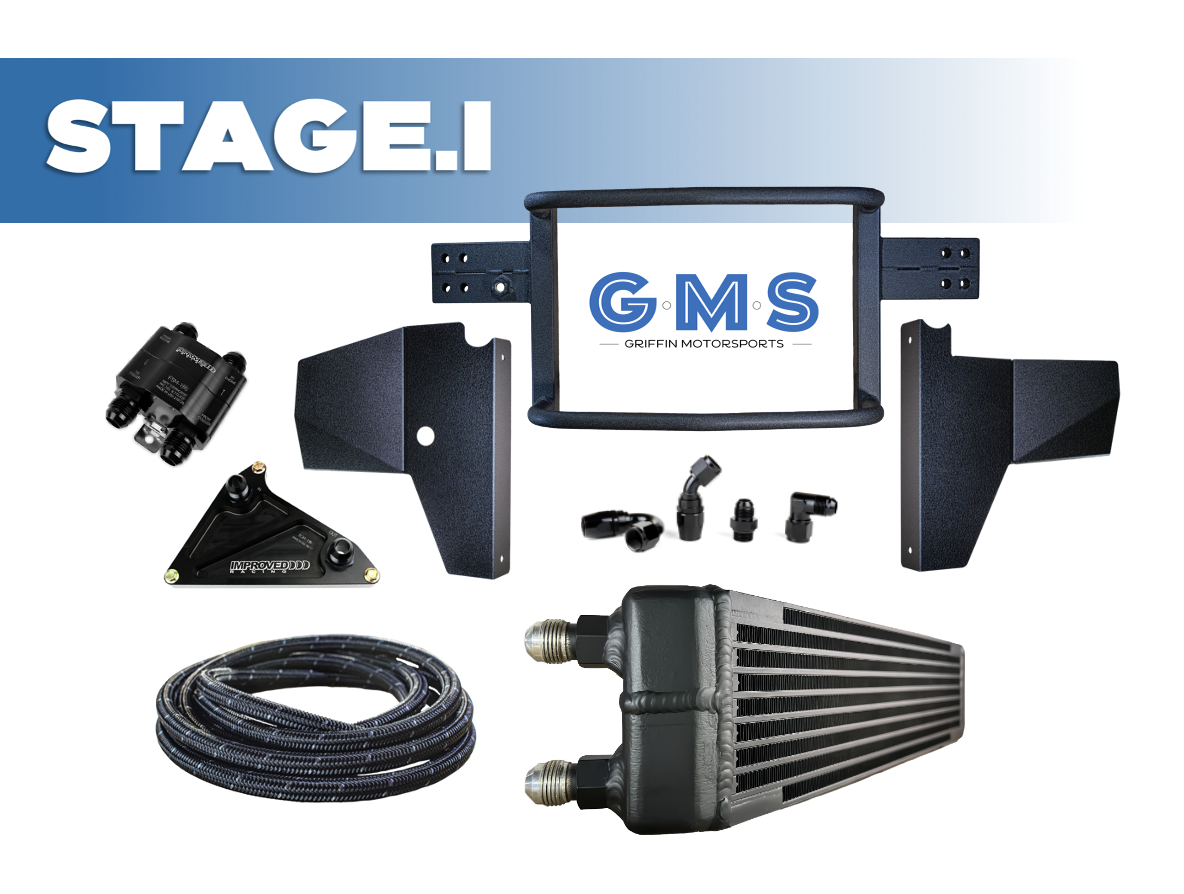
GMS STAGE.I Oil Cooler + Impact Frame Package - The perfect solution to keeping your street cars oil, and supercharger cool at the same time.
Note; with the new release of our larger Stage.II Oil Cooler, we are now re-branding our popular Stage.I kit as “street” and our Stage.II as “track” for a simply delineation.
As you may already know, it’s easy for oil temps to skyrocket on the LT4 platform on the street and at the race track with many seeing oil temps over 300F, which can be an engine killer. One issue with the OEM oil cooler was the decision to cool the oil using your engine coolant. This is not only ineffective on hot days, but it should be obvious that 250F + coolant and the 250F + engine oil, will essentially heat each other as things get spicier and spicier.
The solution? The GMS remote oil cooling package + High Flow Impact Bar Bundle. There are many factors that make our kit the best on the market for your LT platform. Let’s run through them together shall we?
To start, we separate the oil and coolant by removing the OEM oil cooler all together, and replace the undersized OEM unit with a large 22” x 5” x 2.5” dual pass, bar plate unit made by our friends at CSF. It includes built in -10AN male fittings and a classy matte black heat rejecting finish that coordinates perfectly with our High Flow Impact Bar. In fact, this ultra-effective cooler hides perfectly behind the upper portion of the grill and flow-tie thanks to a custom bracket which puts it out of view.
From there, the next big consideration is oil delivery. With your OEM cooler out of the way, we can now install the Improved Racing block of plate. This unit is not only absolutely gorgeous, but it fits perfectly, and includes the -10AN bosses that you need to run proper AN lines and fittings.
The next consideration is temperature control. Our solution is another Improved Racing piece of art, by way of their High Flow inline thermostat. The beauty of this unit lies in it’s ability to allow a very small amount of oil to pass through when closed, which helps bring the stored oil within the cooler to a similar temperature, preventing cold oil, from shocking the system when the thermostat opens. Our optional thermostat includes a 185F thermostat.
Improved Racing maintains exceptionally high quality-control standards. Every single Improved Racing thermostat undergoes rigorous inspection, functional testing, and certification before it leaves their doors. They manufacture all of them in the USA to the strictest standards and back them with a lifetime warranty – your guarantee of lasting performance and peace of mind. This is just one of the reasons we partnered with the team at Improved Racing for these two critical components. Because your car deserves the best.
Bringing them all together is a pair of braided -10AN hose and all of the AN fittings you will need for a super clean and efficient system. We also provide you with a high quality block off kit that allows you to remove the all of the OEM oil cooler lines for a cleaner look, buy installing one 5/8” hose cap and one 5/8” anodized aluminum quick lock cap.
HP RATING; based on the size and location of this #8066 bar and plate cooler, we recommend this option for street cars up to 900rwhp only. Making more power than that? then we recommend you consider our larger Stage.II Oil Cooler Package that includes larger 12AN lines, a larger oil cooler that holds 30% more fluid, and quick connect AN lines provided by DYME.
OIL PRESSURE; On our 900+rwhp test car with a Katech oil pump we saw no change in oil pressure before and after the oil cooler installation. Hot idle before and after ranges from 31.5 - 33.5psi. 6000k + RPM at WOT ranges from 75 - 90psi. No change after the cooler was installed.
VALUE; Our goal was to not only provide you with the best turn-key oil cooling system on the market, but to save you over $350 on parts when purchased as a bundle. We are confident that you will love the design, fitment, attention to detail and performance of this Stage.I oil cooling package.
NEW OPTION AVAILABLE; For those who wish to mount this solution to the OEM crash bar vs. installing our signature high flow crash bar, we now offer a pair of custom laser cut steel brackets with a powder coat finish. These brackets includes precision fit laser cut 1/8” thick rubber gasket mounting pads as well as M8 × 1.25mm Stainless Steel mounting bolts. These brackets require you to tap (3) existing holes found in the OEM crash bar, as well as drill and tap (3) additional for a more stable connection.
This option is only $185 and can be selected below.
What’s in the box;
GMS High Flow Impact Bar Assembly (optional)
Improved Racing Block Off Plate (with hardware)
CSF Dual Pass Oil Cooler (with -10AN male fittings)
Raceflux -10 AN Fittings & braided hose (cut to length)
GMS OEM Oil Cooler Delete fittings (Silicone + Billet Cap)
GMS Brackets to mount direct to the OEM Crash Bar (optional)
(2) 12" lengths of 2,000F Thermal Wrap to protect from headers
Improved Racing High Flow In-line Thermostat + Bracket (optional)
What YOU will need to provide;
Motor Oil (this kit will add almost 2.0 additional quarts) We prefer DRIVEN HP-X.
Patience and attention to detail for installation... or, someone like that, who you trust with your beloved, adorned, magnificent, earth shaking, alarm sounding ZL1.
Optional M8 × 1.25mm drill and tap tool for those who wish to mount this cooler to the OEM crash bar using our optional brackets.
Fitment: 2017-2024 Camaro ZL1. Note; this unit will not fit with the PLM heat exchanger.
Impact Bar Install Guide can be downloaded by clicking THIS link.
Oil Cooler Install Guide can be downloaded by clicking THIS link.
STAGE.I Oil Cooler + Impact Frame Package
As you may already know, it’s easy for oil temps to skyrocket on the LT4 platform on the street and at the race track with many seeing oil temps over 300F, which can be an engine killer. One issue with the OEM oil cooler was the decision to cool the oil using your engine coolant. This is not only ineffective on hot days, but it should be obvious that 250F + coolant and the 250F + engine oil, will essentially heat each other as things get spicier and spicier.
The solution? The GMS remote oil cooling package + High Flow Impact Bar Bundle. There are many factors that make our kit the best on the market for your LT platform. Let’s run through them together shall we?
CLICK HERE TO READ MORE...
from $985.00
Understanding the Camaro ZL1 Oil Cooling System
The LT4 engine found in the Camaro ZL1 generates heat quickly, and oil temperature is one of the first things to climb when you lean on the car. You’ve got a high compression supercharged V8 compressing air, increasing cylinder pressure, and creating much more thermal load than a naturally aspirated setup. What you learn is that your motor oil is not just necessary for lubricating the engine, it is critical for keeping your engine cool. That's because upwards of 20% of the heat generated by the engine is intended to be shed by the oil, and based on your on track oil temps, it’s clear the OEM system needs some help, even at factory power level.
The Camaro ZL1's oil-cooling system is built around an oil-to-coolant heat exchanger. Under normal driving, this works well enough, keeping oil temperatures in the 210°F to 230°F range. The issue shows up during extended pulls, aggressive driving, or worst of all… road racing, when temperatures can quickly pass 280F which can start to affect oil viscosity, engine protection, and a cascade effect that may ultimately put you into limp mode until you can cool the entire car.
The primary limitation stems from the system's dependence on engine coolant. You engine coolant is already handling 20-30% of the LT4’s heat generation. Once the coolant temperature rises, its ability to remove heat from the oil decreases. That’s where you start to see a stacking effect, where both systems struggle to stabilize.
This creates a chain reaction across the car. Oil temps rise, coolant temps follow, intake air temps increase, and power begins to taper off. If you’ve ever noticed the car feeling a bit softer after repeated pulls, that’s heat soak working its way through the entire system rather than a single component failing.
That’s also why monitoring matters, and exactly why we use and promote the use of the Banks iDash for all street and tracked Camaro ZL1’s. The Banks iDash lets you see exactly when temperatures start getting out of range. And if you’re running airflow and power upgrades like the LT4 supercharger, the added boost only increases the demand on the oil cooling system.
Why the Stock ZL1 Engine Oil Cooler Falls Short
The factory ZL1 engine oil cooler does a decent job for daily driving and short bursts of acceleration. It was designed around predictable conditions, moderate ambient temperatures, and limited sustained load. The problem is, most owners don’t leave these cars in that environment for long… especially once modifications come into play.
The biggest limitation is heat capacity. The stock heat exchanger simply doesn’t have enough surface area to keep up when oil temperatures rise quickly. During back-to-back pulls or track sessions, oil temps can climb faster than the system can shed heat. Once you cross into that 250°F to 270°F range, the system is no longer stabilizing; it’s just trying to survive.
Flow restriction is another factor that doesn’t get talked about enough. The factory design prioritizes compact packaging, which means tighter internal passages. As oil temperature increases, viscosity drops, but high RPM demand increases flow requirements. That mismatch can create inefficiencies, leading to oil that isn’t cooled evenly or effectively.
Then there’s the shared load with the cooling system. Since the oil cooler relies on engine coolant, both systems are fighting the same battle. When coolant temps rise, oil-cooling efficiency drops, and you’re stacking heat across the entire system. This is why we always recommend considering ZL1 cooling mods rather than treating oil cooling as a standalone fix.
What Upgraded Camaro ZL1 Oil Coolers Actually Fix
Upgrading the oil cooler on a ZL1 isn’t just about chasing lower numbers on a gauge. It’s about controlling how heat builds, how it’s removed, and how consistently the system performs under repeated load. When you break it down, the improvements come from a few key areas:
Increased Cooling Surface Area
The biggest difference comes from size and airflow exposure. Larger external coolers provide more surface area for heat to transfer from the oil into the air. In real-world testing, this typically drops peak oil temperatures by 25°F to 45°F, depending on driving conditions, HP and the aggressiveness of the setup.
Separation from the Coolant System
The factory system leans heavily on coolant to regulate oil temperature, which creates problems once both systems heat up together. An upgraded cooler shifts that workload toward ambient air, reducing the dependency on coolant. This helps stabilize both oil and coolant temps, rather than letting them compound.
Improved Airflow Routing
Placement matters more than most people expect. A well-designed setup positions the cooler in a high-pressure airflow zone, often with ducting to guide air directly through the core. This allows the system to cool consistently at speed instead of relying on passive heat exchange.
Reduced Flow Restriction
Aftermarket coolers are typically built with smoother internal passages and larger lines. This allows oil to circulate more efficiently at high RPM, improving overall cooling consistency. It also reduces unnecessary strain on the oil pump during extended hard driving.
System Integration with Other Mods
Oil cooling works best when it’s part of a larger strategy. When combined with our GMS High Flow Impact Bar and upgraded main front heat exchanger, the cooler helps stabilize temperatures across the entire engine. The result is repeatable performance, with the car able to handle multiple hard pulls without temperatures continuing to climb.
Breaking Down the GMS Stage.II Oil Cooler package
A proper ZL1 oil cooling kit isn’t just a bigger radiator for your oil. It’s a combination of components that work together to control temperature, maintain flow, and survive real-world driving conditions. The difference between a basic add-on and a complete kit shows up quickly once you start pushing the car:
External Bar and Plate Oil Cooler Core
This CSF built beauty is the heart of the system. The bar-and-plate core transfers heat more efficiently than thinner factory cores. It’s core size and thickness matter here, as they directly affect how much heat can be removed during sustained driving. This is not a guess, that statement is backed by repeated back to back testing measuring oil temps before and after the cooler on both our Stage.I and Stage.II kits giving us the data we need, actually move the needle on oil temps.
Oil Lines and Fittings
Lines are often overlooked, but they play a huge role in both flow and durability. A quality kit uses high-temperature, high-pressure lines with larger internal diameters to reduce restriction. Proper fittings also prevent leaks and maintain consistent oil pressure under load. Our kit utilizes -12 lines and offers an upgrade to DYME quick connect fittings giving you the ability to install, remove and drain the system quickly, while giving you a leak free peace of mind installation.
GMS High Flow Impact bar and Airflow Placement
Mounting isn’t just about holding the cooler in place. It determines how well the system actually works. A good kit positions the cooler to receive direct airflow, often paired with ducting or shrouding to maximize efficiency at speed. This is why we created a custom High Flow Impact Bar to help position the larger Stage.II Oil Cooler in the position that works best.
System Compatibility
A well-designed kit integrates cleanly with existing Camaro ZL1 cooling efforts and doesn’t interfere with other cooling components like AUX coolers. Fitment around the front end, intercooler system, and heat exchangers is critical. This is also where planning matters, especially if you’re stacking multiple upgrades.
Real Temperature Data: Stock vs Upgraded Oil Cooling
Numbers tell the story better than opinions, especially with something like oil temperature. We’ve logged multiple ZL1s in different conditions, from street pulls to extended track sessions, and the pattern is consistent. The stock setup works fine until it doesn’t have enough time or capacity to recover.
With the GMS Stage.II oil cooler you will see oil temps that are much harder to increase. More importantly, recovery happens so much faster than with the OEM system. Not to mention, now that you have separated the the engine coolant from the oil cooler you will see your engine coolant temps run 20-30F cooler on average and show much better heat soak resistance now that the 300F oil temps are not bleeding heat into the system.
At some point, higher ambient temps, higher HP builds may eventually get temps past the point of no return. Although it may not be possible to avoid that 100%, what we can do, through careful planning is provide you a cooling system that buys you as much time on the track as possible.
How Oil Cooling Fits Into Your Full ZL1 Cooling Setup
Oil cooling is one piece of a much larger thermal system on the ZL1. Every component under the hood is either generating heat or trying to manage it, and they all influence each other more than most people expect. To understand how an oil cooler really performs, you have to look at how it fits into the bigger picture:
Airflow Across the Front End
The front of the ZL1 is packed with heat exchangers, all competing for incoming air. The radiator, intercooler system, and auxiliary coolers rely on consistent airflow to function properly. Supporting ZL1 cooling mods help guide and maximize that airflow, allowing the oil cooler to actually do its job instead of fighting turbulence and restriction.
Relationship with Intake Air Temperatures
Oil temperature doesn’t just affect lubrication; it contributes to overall engine bay heat. As temperatures rise, that heat can impact intake air temperatures and reduce the efficiency of the supercharger system. This becomes more noticeable on setups running upgrades like the LT4 supercharger, where managing heat is critical for maintaining consistent power.
System Monitoring and Feedback
Without data, it’s hard to know how well your setup is working. Monitoring oil and coolant temperatures, along with recovery rates, gives you a clear picture of how the system behaves under load. A proper set of gauges allows you to catch rising temps early and understand how each upgrade affects overall performance.
Balancing the Entire Cooling System
The goal isn’t just to cool one component better; it’s to create balance across the system. Oil cooling, intercooling, and engine cooling must work together to prevent heat buildup. When everything is dialed in, the car stays consistent through repeated pulls and recovers faster between runs.
Choosing the Right Camaro ZL1 Oil Cooler for Your Build
Choosing the right Camaro ZL1 oil cooler comes down to how you actually use the car. A street-driven setup that sees occasional pulls has very different demands compared to a car that spends time on the track. The goal isn’t to install the largest possible cooler; it’s to match capacity, airflow, and flow efficiency to your specific driving conditions. This is why we offer two flavors of oil cooler. One for STREET and one for TRACK.
Street vs Track Use
For street-focused cars, the priority is managing short bursts of heat and quick recovery between pulls. A moderate-sized cooler with proper airflow is usually enough to keep temps in check. Track cars are a different story, where sustained high RPM and continuous load require larger cores and more aggressive cooling capacity to prevent temps from creeping upward lap after lap.
Cooler Size and Placement
Bigger isn’t always better if airflow isn’t there to support it. A properly sized cooler placed in a high-velocity airflow zone will outperform a larger unit stuck in a low-velocity airflow zone. Fitment also matters, especially when working around other Camaro ZL1 parts in the front end. Clean routing and proper positioning make a noticeable difference in real performance.
Thermostat vs Always-On Cooling
Some setups benefit from a thermostat that regulates when oil flows through the cooler. This helps maintain proper operating temperature during normal driving. For more aggressive builds, especially those seeing track time, a more direct cooling approach may be preferred to keep temps consistently lower under load.
Supporting Modifications
An oil cooler works best when paired with the right supporting upgrades. Airflow improvements, intercooler efficiency, and overall system balance all play a role. This is where combining upgrades with other Camaro ZL1 aftermarket parts helps create a setup that performs consistently, rather than just solving one part of the problem. An oil cooler works best when installed alongside a Camaro ZL1 Triple Heat Exchanger to manage every fluid temperature under sustained boost.
Installation and Long-Term Reliability
Most oil cooler kits fall into a moderate installation range, typically taking a few hours with careful attention to line routing and mounting. Long-term reliability comes down to quality components, proper fitment, and making sure everything is secured away from heat and moving parts. A well-installed system should handle repeated use without constant adjustment.
At the end of the day, the right setup is the one that keeps your temperatures stable for how you drive. Not the biggest, not the most complex, just the one that works consistently when you need it to. Discover our driven oil for 6th gen camaro as the ideal partner to a properly sized oil cooler for track-day durability.
Frequently Asked Questions About Camaro Zl1 Oil Cooler
-
Oil temperatures above 280°F start to reduce oil effectiveness, especially during repeated high-load driving. Occasional spikes may happen, but sustained temps in that range should be addressed.
-
A properly designed system maintains stable oil pressure. In fact, reduced restrictions and improved flow routing can improve consistency under high-RPM conditions.
-
Yes, controlling oil temperature helps preserve viscosity and reduces wear on internal components, such as bearings and camshafts, over time.
-
No tuning is required for most oil-cooler upgrades, since they are mechanical systems. However, monitoring data after installation is always recommended.
-
Even with better cooling, oil change intervals should follow your usage. Track-driven cars still require more frequent changes due to higher stress.