
BMR Front Driveshaft Safety Loop Zl1 Camaro
High-performance cars like the Camaro ZL1 generate enormous drivetrain forces. With the supercharged LT4 producing 650 horsepower and strong torque across the rev range, the driveshaft experiences intense rotational load during acceleration. Add sticky tires, aggressive launches, or additional power modifications, and the stress placed on the driveline increases quickly. A driveshaft safety loop is a simple yet important component that helps contain the shaft in the event of a failure, protecting the underside of the vehicle and surrounding drivetrain components.
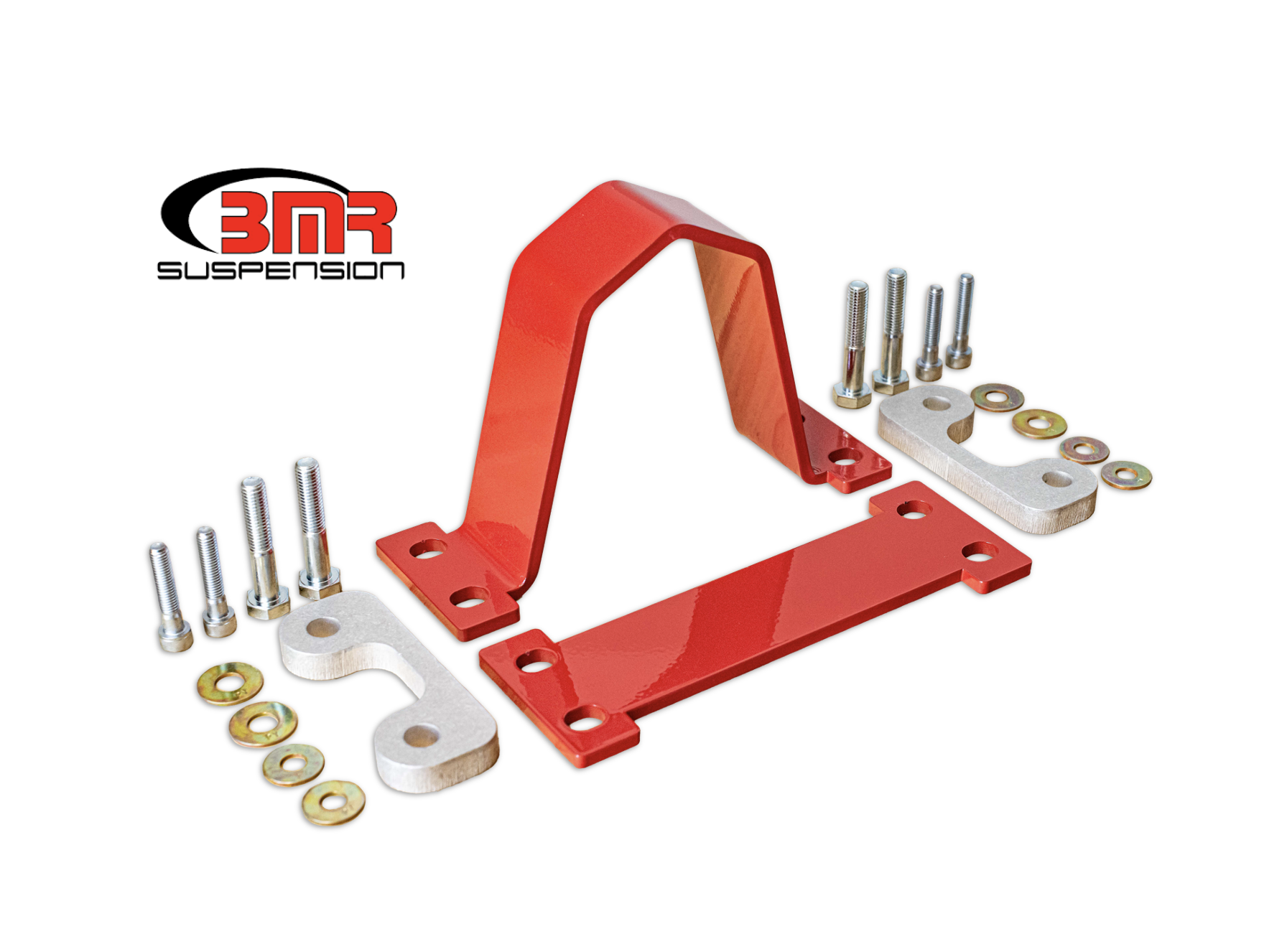
BMR Driveshaft Safety Loop (Bolt-In) – Red – DSL019R
Protect your investment. Stay legal, and drive harder with confidence.
If you’re making real power (or running sticky tires), a driveshaft failure isn’t just “inconvenient” it can be catastrophic. When a driveshaft lets go at speed, it can slam into the floor of your beloved Camaro, damage the tunnel, take out critical underbody components, or pole-vault the car under extreme conditions. A driveshaft safety loop is cheap insurance that can save you thousands—and it’s often a requirement to pass tech once you start chasing quicker ETs.
The BMR DSL019R is a bolt-in driveshaft safety loop designed to mount using factory driveshaft tunnel mounting points, creating a rigid, properly located containment hoop that helps keep the driveshaft where it belongs if a U-joint, driveline, or transmission event happens.
Why a Safety Loop Matters.
At high torque loads, hard launches, aggressive shifts, drag radial prep, clutch dumps, or track abuse, the driveline sees sharp torque spikes and torsional oscillation. Add wheel hop, sticky tires, or higher RPM shifts and you’ve got the perfect recipe for a weak link to fail. When it does, the loop’s job is simple:
Contain the driveshaft and reduce the chance of it striking the floor/tunnel
Reduce collateral damage to exhaust, wiring, lines, and underbody structure
Help meet track safety rules so you don’t get turned away at tech
NHRA / Track Tech Context
Many tracks follow NHRA-style safety guidance, and a safety loop becomes a common requirement once you’re quicker. Retailers and manufacturers commonly reference requirements such as:
Quicker than 13.99 with sticky tires, or
Quicker than 11.49 on street tires
(Always confirm your local track’s exact rules, but this is the “why” behind the purchase.)
Construction & Engineering Highlights
BMR builds the DSL019 as a serious piece—not a flimsy strap:
1/4-inch laser-cut steel plate, CNC-formed for strength and repeatability.
Bolt-in design that utilizes OE mounting locations in the factory tunnel area.
Includes Grade 8 hardware (strong clamping force and durability under vibration/heat cycles).
Compatibility notes often called out by retailers: revised design intended to work with MGW shifter and ARH exhaust systems.
Real-World Benefits
Confidence on launch and on the big end – especially on drag radials / slick-adjacent tires
Cheap insurance compared to tunnel repair, exhaust replacement, or drivetrain carnage
Track-day readiness – stop stressing tech inspection surprises
“Do it once” chassis safety mod that pairs perfectly with higher-power LT builds
If your customer is already doing exhaust, driveshaft, trans, diff, or cradle work—this is the perfect time to add it. Also, while you are in that area, we HIGHLY recommend installing a JXB Center bearing support while you are in there.
NOTE: We do keep this product on the shelf, but based on a small PAR stock, this product may ship direct from the manufacture within 1-3 days of ordering. If you need this item ASAP, please email us HERE to confirm shipping times and stock levels.
Fitment Guide: BMR DSL019R Driveshaft Safety Loop fits:
2016–2024 Chevrolet Camaro (6th Gen)
2015–2019 Cadillac CTS-V (3rd Gen)
BMR 6th Gen. Front Driveshaft Safety Loop
If you’re making real power (or running sticky tires), a driveshaft failure isn’t just “inconvenient” it can be catastrophic. When a driveshaft lets go at speed, it can slam into the floor of your beloved Camaro, damage the tunnel, take out critical underbody components, or pole-vault the car under extreme conditions. A driveshaft safety loop is cheap insurance that can save you thousands—and it’s often a requirement to pass tech once you start chasing quicker ETs... CLICK HERE TO READ MORE...
$135.00 Original Price:$150.00
Why The Camaro ZL1 Needs A Driveshaft Safety Loop
The Camaro ZL1 puts a serious load on the drivetrain. The LT4 engine produces 650 horsepower and 650 lb-ft of torque, which means the driveshaft is spinning at several thousand RPM during hard acceleration. Under those conditions, a failure at the universal joint or transmission yoke can allow the front of the driveshaft to drop and strike the pavement or the underside of the car. When that happens, the shaft can whip through the transmission tunnel, damage exhaust components, or destabilize the vehicle.
This is why many racing organizations require a Camaro ZL1 driveshaft safety loop for cars running high power or sticky tires. The loop acts as a containment point around the front section of the driveshaft. If the shaft separates, it is caught before it can hit the pavement or swing into the chassis.
As ZL1 owners begin adding upgrades such as camaro zl1 aftermarket parts, improved monitoring like zl1 gauges, airflow improvements such as the lt4 supercharger lid upgrade, and thermal upgrades like zl1 cooling mods, drivetrain protection becomes an important part of the system. A BMR Front Driveshaft Safety Loop ZL1 Camaro helps contain one of the most vulnerable components under high load without affecting normal driving.
How The BMR Driveshaft Safety Loop ZL1 Improves Drivetrain Safety
The BMR driveshaft safety loop ZL1 is designed to address one of the most vulnerable areas of the Camaro ZL1 drivetrain. When power, traction, and drivetrain load increase, the risk of driveshaft separation grows as well. A properly engineered safety loop contains the driveshaft during a failure event and helps protect surrounding components:
Driveshaft Containment During Failure
Most driveshaft failures occur near the transmission output shaft, where the driveshaft connects to the drivetrain. If the shaft separates at high RPM, the front section can immediately drop and strike the pavement or the underside of the car.
The BMR loop surrounds this portion of the shaft. If a failure occurs, the loop quickly catches the shaft and prevents it from whipping into the transmission tunnel, the exhaust system, or chassis components.
Heavy Duty Steel Construction
BMR builds the loop using thick steel brackets and a formed steel containment ring designed to withstand high loads. The goal is simple. The structure must be rigid enough to stop a spinning driveshaft while remaining securely mounted to the vehicle chassis.
This design allows the loop to handle sudden shock loads that can occur during drivetrain failure while maintaining consistent alignment with the driveshaft.
Designed For Proper Clearance
A driveshaft safety loop has to balance containment and clearance. Too tight, and it risks contact with the shaft during normal operation. Too loose, and it loses effectiveness during a failure event.
BMR engineers position the loop around the front section of the driveshaft with controlled spacing that allows full driveshaft rotation while keeping the containment point close enough to stop sudden movement.
Fast Installation For ZL1 Owners
Another benefit of the BMR drivetrain safety loop is the straightforward installation. Most Camaro ZL1 owners with basic tools can complete the install in about 45 to 60 minutes.
The loop mounts directly to the chassis mounting points with supplied hardware, meaning no major drivetrain disassembly is required. For enthusiasts already working on their cars or installing other upgrades, this makes it a practical addition alongside other camaro zl1 parts that support the platform.
Engineering Behind The BMR Drivetrain Safety Loop
The BMR drivetrain safety loop is engineered to contain a high-speed rotating driveshaft while maintaining the clearance required for normal drivetrain operation. In the Camaro ZL1, the driveshaft can spin at several thousand RPM during hard acceleration. If a universal joint or connection point fails, the containment system must react immediately and prevent the shaft from dropping toward the pavement or striking the underside of the vehicle.
To handle that situation, BMR uses heavy-gauge steel brackets and a reinforced formed loop designed to withstand sudden shock loads. The loop surrounds the front portion of the driveshaft near the transmission output shaft, which is the most common failure point in high-power drivetrains. By placing the containment point close to this area, the loop can intercept the shaft quickly and reduce the chance of damage to the transmission tunnel, exhaust system, or surrounding components.
The BMR transmission safety loop Camaro design also focuses on proper fitment with the sixth-generation Camaro chassis. It mounts to strong chassis points, keeping the structure stable while maintaining safe clearance for driveshaft rotation. Because the system is built specifically for the platform, it integrates cleanly with other upgrades and supporting camaro zl1 parts often added to high-performance ZL1 builds.
Installation Overview For The BMR Transmission Safety Loop Camaro
Installing the BMR transmission safety loop Camaro is a straightforward upgrade that adds an extra layer of drivetrain protection without requiring major disassembly. The system is designed specifically for the sixth-generation Camaro ZL1 chassis, which allows it to mount to existing structural points under the vehicle. Most owners with basic hand tools can complete the installation in about 45 to 60 minutes, making it a practical addition during routine maintenance or while installing other performance upgrades.
The installation process typically begins by safely raising the vehicle and locating the mounting points near the front section of the driveshaft and transmission tunnel. The BMR brackets attach to the chassis using supplied hardware, and the steel loop is positioned around the driveshaft with proper clearance for full rotation. Once secured, the loop sits close enough to the shaft to catch it during a failure event but remains completely clear during normal driving conditions.
Because the loop integrates cleanly with the Camaro platform, it does not interfere with exhaust routing or drivetrain movement when installed correctly. Many ZL1 owners install the safety loop while working on other performance upgrades or browsing Camaro ZL1 aftermarket parts to build a balanced system that supports both performance and drivetrain protection.
Pairing The Safety Loop With Other Camaro ZL1 Performance Upgrades
As power levels increase on the Camaro ZL1, upgrades often work best when viewed as part of a system rather than individual parts. The ZL1 safety loop upgrade fits into that approach by protecting the drivetrain, while other modifications focus on power, cooling, and monitoring. Once traction improves and torque delivery becomes more aggressive, the load on the driveshaft increases, making containment upgrades like the safety loop more relevant.
Many ZL1 owners begin by improving airflow and reducing heat soak in the LT4 platform. Upgrades such as the lt4 supercharger lid upgrade help manage intake air temperatures during repeated pulls, while dedicated zl1 cooling mods help stabilize engine and intercooler temperatures during track sessions or extended driving. When power delivery becomes more consistent, the drivetrain sees more frequent high-load conditions.
Monitoring and supporting hardware also play a role in a balanced build. Many enthusiasts add upgraded zl1 gauges to track boost pressure, coolant temperature, and other key engine data while running performance setups. Combined with properly selected camaro zl1 parts, these upgrades help create a ZL1 that not only produces strong power but also maintains reliability under hard use. In that environment, the BMR front-drive safety loop is a simple addition that helps protect the drivetrain when the car is operating at its highest capability.
Is A ZL1 Safety Loop Upgrade Worth It For Street And Track Cars?
For many Camaro ZL1 owners, the ZL1 safety loop upgrade becomes more relevant as power levels and traction increase. The LT4 platform already produces strong torque from the factory, and once owners add stickier tires, pulley changes, or airflow upgrades, the load placed on the drivetrain rises quickly. Under those conditions, the driveshaft is operating at high rotational speed and is subject to repeated shock loads during hard launches or aggressive shifts.
A safety loop does not add horsepower, but it addresses a real mechanical risk in high-performance drivetrains. If the driveshaft separates at the transmission, the front of the shaft can drop and strike the pavement while spinning at several thousand RPM. A properly positioned BMR front driveshaft safety loop ZL1 Camaro catches the shaft and keeps it contained inside the loop, helping reduce the chance of damage to the transmission tunnel, exhaust system, and surrounding components.
For street-driven ZL1 builds, the upgrade adds peace of mind with minimal installation time and no effect on normal driving. For cars that see drag strip launches or regular track use, the loop becomes even more valuable since drivetrain components experience higher stress during repeated acceleration cycles. Many owners consider it a practical addition alongside other supporting modifications that keep the Camaro ZL1 operating reliably as performance levels climb.
Frequently Asked Questions About BMR Front Driveshaft Safety Loop Zl1 Camaro
-
Most BMR safety loops are built from heavy-gauge steel designed to withstand sudden drivetrain shock loads. The material choice provides the strength needed to contain a rotating driveshaft while maintaining long-term durability under heat, vibration, and road conditions.
-
In most cases, the change in ground clearance is minimal. The loop is designed to sit close to the transmission tunnel and driveshaft area, which keeps it tucked within the chassis profile so it does not significantly affect normal street driving.
-
A properly installed loop does not contact the driveshaft during normal operation. Since there is controlled clearance around the shaft, the driveline spins freely without introducing additional vibration.
-
Many drag racing organizations require driveshaft loops for cars running quicker elapsed times or using sticky tires. The requirement exists because the loop helps contain the driveshaft during a failure event, improving safety for both the driver and the track environment.
-
Yes, most safety loops are designed to work with both factory and common aftermarket driveshaft options. However, it is always a good idea to verify clearance if the vehicle uses a larger diameter aluminum or carbon fiber shaft.
-
Maintenance is minimal. Periodic inspections during routine vehicle servicing are recommended to confirm that mounting hardware remains tight and that the loop maintains proper clearance around the driveshaft.
-
Most systems are designed with the factory exhaust routing in mind. However, some larger aftermarket exhaust setups may require a quick clearance check during installation to ensure proper spacing between components.
-
Yes. Both automatic and manual ZL1 models place a significant load on the driveshaft during acceleration. The loop provides the same containment protection regardless of transmission type.
-
The added weight is relatively small, usually only a few pounds. Because the component mounts near the chassis center, it has little effect on overall vehicle balance.
-
Many designs allow installation without removing the driveshaft. The loop is typically installed in sections or positioned around the shaft using mounting brackets attached to the chassis.