
BMR Rear Double Adj. Rod Ends Toe Rods For Zl1 Camaro
The Camaro ZL1 is built with one goal in mind: performance. With the supercharged LT4 pushing over 650 horsepower and a sophisticated independent rear suspension, the platform responds extremely well to upgrades that tighten control and reduce unwanted movement. One area that often gets overlooked is rear toe stability. The factory toe rods do their job for everyday driving, but under hard acceleration, aggressive cornering, and track use, the rubber bushings can allow small alignment changes that affect how the rear tires stay planted.
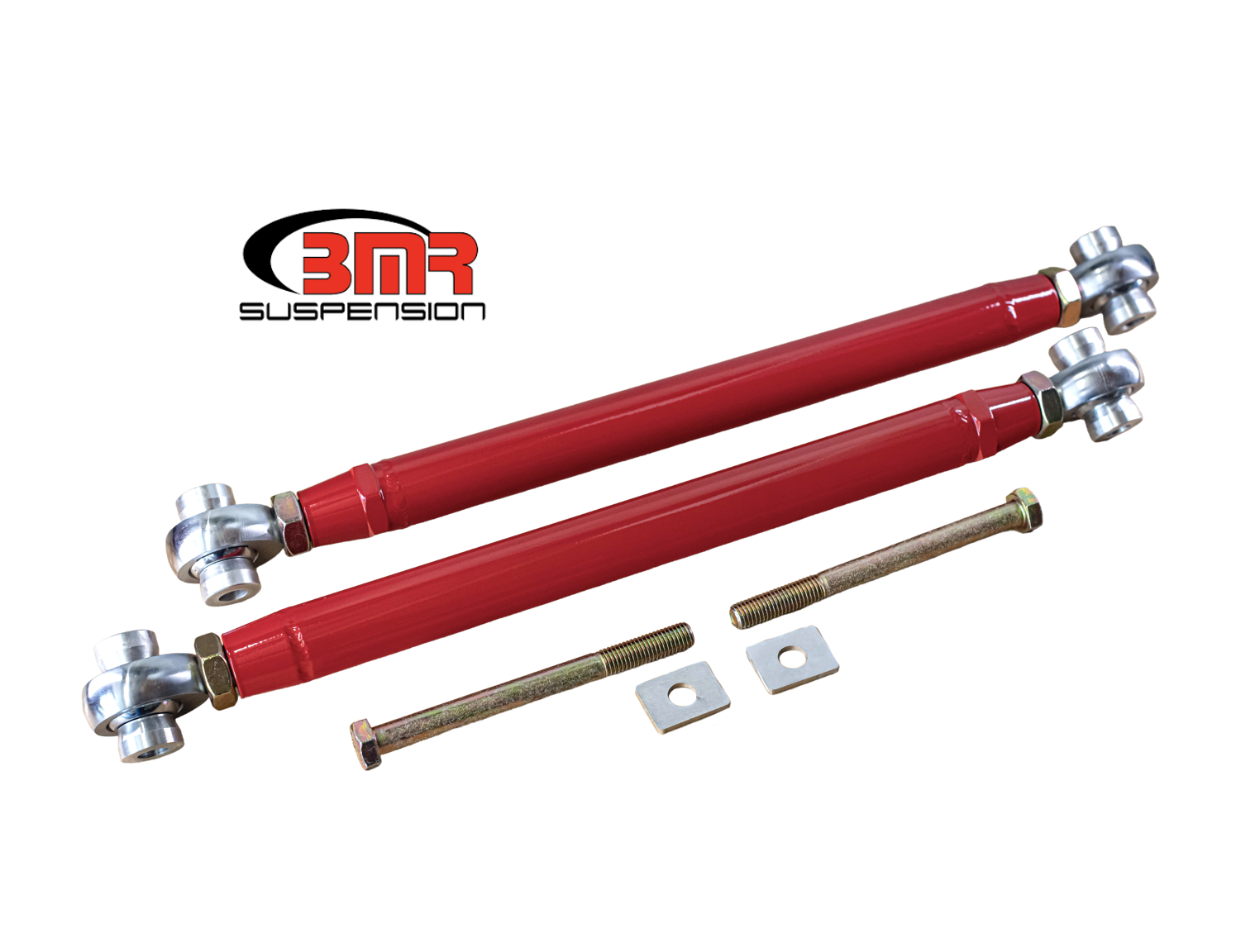
BMR Rear Toe Links (Double Adjustable Toe Rods) – Red – #TR007R
Lock your alignment in place. Eliminate rear toe “wiggle.” Put the power down harder and carry more confidence through corners.
If you’ve ever felt the rear of your 6th-gen Camaro get a little “nervous” under load, hard launches, aggressive cornering, or big braking zones, there’s a good chance your factory stamped toe links and eccentric adjusters are flexing. That compliance changes rear toe dynamically, which can show up as instability, inconsistent handling, or wheel hop.
The BMR TR007R rear toe links are built to solve that problem with a true performance toe solution: rigid construction, double adjustability, and lockout plates that remove the weak link (the factory eccentric toe adjusters). It is widely known that the factory toe rods can deflect under load and change alignment, while the upgradedTR007 lets you fine-tune toe and reduce flex for consistent results.
Why rear toe links matter.
Rear toe is one of the biggest contributors to how “planted” the car feels, especially on IRS cars when the suspension is loaded.
Compliance = dynamic toe change. Under cornering/acceleration loads, parts flex. If rear toe changes mid-corner or mid-launch, the car feels unpredictable. BMR’s testing specifically points out the stock toe rods flex and can cause inconsistent alignment/handling.
Eccentric adjusters can slip. The factory eccentric bolts are convenient for alignment, but they’re not ideal for repeated high load. BMR addresses this by including lockout plates so adjustments happen on the toe rod itself (not the eccentric).
More grip + more power = more demand on the hardware. Sticky tires and higher horsepower amplify the load and the need for a toe link that doesn’t move around or flex.
Bottom line: stable toe = stable rear end. That’s what you’re buying here.
Engineering highlights (what makes TR007R different) BMR didn’t just make an “adjustable link”, they built a link meant to survive real performance use:
TIG-welded 1-1/4" DOM steel tubing for stiffness and durability.
Chromoly tube adapters with right- and left-hand threads for fast, precise on-car adjustments.
Zinc-plated, heat-treated chromoly rod ends that are self-lubricating and Teflon-lined for smooth articulation and longevity.
6061-T6 billet aluminum rod end spacers to properly locate the rod ends and maintain strength.
Rear toe lockout plates to eliminate factory eccentric adjusters and help prevent toe change/slip.
Red powdercoat finish (TR007R) for corrosion resistance and that “racecar under the car” look.
Made in the USA.
Real-world benefits you’ll feel.
More consistent handling during track driving and spirited canyon runs (less rear steer, less “float”)
Better stability under power (especially with sticky tires and hard launches)
Reduced wheel hop potential by removing flex and keeping the rear alignment where you set it
Faster, easier alignment tuning thanks to on-car double adjustability—dial toe without fighting the factory eccentric setup
What’s included.
(2) Double adjustable rear toe links / toe rods
Lockout hardware/plates to eliminate factory eccentric toe adjustment
Required installation hardware
Installation notes.
BMR states typical install time is about ~2 hours.
BMR’s instructions note GM considers the outer toe rod bolts “torque-to-yield” (single use) and provides replacement part numbers and torque-angle guidance.
After installation: get a proper alignment (rear toe is not a “set it and forget it” parameter).
NOTE: We do keep this product on the shelf, but based on a small PAR stock, this product may ship direct from the manufacture within 1-3 days of ordering. If you need this item ASAP, please email us HERE to confirm shipping times and stock levels.
Fitment Guide:
2016–2024 Chevrolet Camaro (6th Gen)
BMR 6th Gen. Rear Toe Link Rod Ends
If you’ve ever felt the rear of your 6th-gen Camaro get a little “nervous” under load, hard launches, aggressive cornering, or big braking zones, there’s a good chance your factory stamped toe links and eccentric adjusters are flexing. That compliance changes rear toe dynamically, which can show up as instability, inconsistent handling, or wheel hop... CLICK HERE TO READ MORE...
$425.00
Rear Suspension Toe Control In The Camaro ZL1
Rear toe control plays a major role in how the Camaro ZL1 behaves under acceleration, braking, and cornering. The rear toe rods determine the angle of the rear wheels relative to the car's centerline. Even small changes in toe angle can affect traction, stability, and how predictable the car feels when power from the LT4 is applied. During hard driving, the rear suspension compresses and loads the toe links heavily, which is why their design matters.
The factory ZL1 toe rods use rubber bushings to isolate vibration and maintain comfort during daily driving. While that design keeps the ride smooth, the rubber can flex under higher loads. When the suspension is pushed hard on sticky tires or during aggressive launches, that flex can allow slight alignment changes. Drivers sometimes notice the rear of the car feeling unsettled during corner exit or when applying throttle because the toe angle shifts more than intended.
At Griffin Motorsports, we often see ZL1 owners addressing this as part of a broader performance setup that includes upgrades like camaro zl1 aftermarket parts to support the platform as a whole. Improving toe control helps keep the rear tires planted and the alignment consistent, which becomes increasingly important as power, grip, and track use increase.
Why The Factory Rear Toe Rods On The Camaro ZL1 Become A Limiting Factor
The Camaro ZL1 leaves the factory with a well-engineered independent rear suspension, but the toe rods are built around comfort and long service life rather than high-load track use. The factory links rely on rubber bushings at each mounting point. Under moderate driving, they work well, absorbing vibration and road harshness. Once the car is pushed harder, those bushings begin to deflect. That deflection allows small but noticeable changes in rear toe angle while the suspension is loaded.
During acceleration, the rear suspension squats and loads the toe links heavily. On a ZL1 producing over 650 horsepower, the forces traveling through the rear suspension components are significant. Rubber bushings can compress several millimeters under load. That movement may not sound like much, but it can translate into measurable alignment changes. Drivers often notice this during corner exits or high-speed transitions, when the rear end feels less planted than expected.
This limitation becomes more noticeable as owners start upgrading the platform. Sticky tires, suspension changes, and power modifications increase the loads acting on the rear suspension. Many ZL1 builds that include upgrades from our camaro zl1 parts catalog eventually reach the point where the factory toe rods become the weak link in maintaining consistent rear alignment.
How BMR Rear Toe Rods ZL1 Improve Rear Suspension Geometry
Rear suspension geometry plays a major role in how the Camaro ZL1 puts power to the ground. When toe angles shift under load, the rear tires lose consistency in how they contact the pavement. Upgrading to bmr rear toe rods zl1 helps stabilize those alignment settings and reduces unwanted movement in the suspension system:
Stronger Construction Reduces Deflection
The factory toe rods rely on rubber bushings that can compress when the suspension is heavily loaded. Under aggressive driving, those bushings allow small movements that alter the rear toe angle.
BMR replaces those soft bushings with precision rod ends. Rod ends provide a solid pivot point with far less deflection, keeping the suspension geometry closer to the alignment settings you dialed in. The result is a rear suspension that responds more consistently during acceleration and cornering.
Double Adjustable Design For Accurate Alignment
A major advantage of BMR’s design is the double-adjustable feature built into the rod body. This allows the toe setting to be changed without removing the rod from the vehicle.
In a shop environment, this saves time during alignment work. More importantly, it allows precise adjustments down to very small increments. Track drivers often fine-tune rear toe depending on tire setup and driving style, and a double-adjustable rod makes those adjustments much easier.
Improved Stability During High-Load Driving
During testing and customer feedback sessions, upgraded toe rods often become noticeable during corner exit and high-speed transitions. With less flex in the rear toe link, the rear tires stay aligned more consistently with the direction of travel.
That consistency becomes even more valuable on cars running additional performance upgrades. For example, ZL1 owners monitoring temperatures through zl1 gauges while pushing the car at track days often notice how improved suspension control helps maintain predictable handling lap after lap.
Engineering Breakdown Of BMR Double Adjustable Toe Rods
Suspension parts might look simple at first glance, but the design details determine how they perform under real load. The BMR double adjustable toe rods are built to handle the forces generated by a 650+ horsepower ZL1 while keeping rear alignment stable during aggressive driving. Looking closer at the engineering behind the rods explains why they are such a common upgrade:
Heavy Duty DOM Steel Construction
BMR builds these toe rods using thick-wall DOM steel tubing rather than the lighter materials used in factory components. DOM, or Drawn Over Mandrel steel, provides excellent strength while maintaining consistent wall thickness across the tube.
In practical terms, that strength reduces flex in the rod body when the suspension is loaded during hard acceleration or cornering. Less flex means the toe setting you dial in during alignment stays much closer to that value when the car is actually being driven hard.
Precision Rod Ends For Accurate Movement
Instead of rubber bushings, BMR uses spherical rod ends at each mounting point. These rod ends allow the suspension to articulate smoothly while removing the soft compression found in rubber components.
That design keeps the toe link moving in a precise arc with the suspension. When the rear control arms cycle through their range of motion, the toe rod maintains accurate geometry instead of compressing and rebounding like a bushing setup.
On Car Adjustability Built Into The Rod Body
The double-adjustable center section is one of the most useful features for both shops and enthusiasts who handle their own alignment work. By rotating the center adjuster, technicians can fine-tune the rear toe without disconnecting the rod ends from the suspension.
That saves time during installation and makes trackside adjustments realistic for drivers who like experimenting with suspension setup. Cars running additional upgrades like zl1 cooling mods for extended track sessions benefit from this kind of adjustability, since suspension settings can be refined as driving conditions change.
Installation And Adjustment Of ZL1 Adjustable Toe Rods
Upgrading to ZL1 adjustable toe rods is a relatively straightforward suspension modification, but proper installation and alignment are important to get the full benefit from the upgrade. The process begins by lifting the vehicle and removing the rear wheels to access the factory toe rods that connect the rear knuckle to the chassis mounting point. Once the mounting bolts are removed, the stock rods can be taken out. Before installing the BMR units, many installers measure the factory rod length and set the new rods close to that same measurement. This provides a good baseline so the vehicle can be driven safely to an alignment rack.
After the BMR rods are installed, the double-adjustable center section allows technicians to fine-tune the rod length directly on the vehicle. This makes it easier to dial in rear toe settings without disconnecting the suspension components. A professional alignment should always follow the installation, since rear toe adjustments as small as a few tenths of a degree can noticeably change stability and corner exit behavior. Many ZL1 owners perform this suspension upgrade alongside power improvements like the lt4 supercharger lid upgrade, since increased power places additional load on the rear suspension and makes precise alignment control even more important.
Real Performance Benefits Of Camaro ZL1 Rear Rod Ends
Upgrading to Camaro ZL1 rear rod ends changes how the rear suspension behaves when the car is pushed hard. The biggest difference most drivers notice is consistency. With the factory rubber bushings removed from the equation, the rear toe angle stays much closer to the alignment settings under acceleration and cornering loads. That stability translates directly into better traction and a more predictable rear end when applying power.
Drivers who track their ZL1 often report improved corner-exit control after installing rod-end-style toe rods. When the suspension compresses during throttle application, the wheels maintain their intended angle instead of shifting slightly due to bushing flex. The result is a rear tire contact patch that stays more consistent. On a high-power platform like the ZL1, even small improvements in rear alignment stability can help the car feel more planted when exiting corners or during high-speed transitions.
Another benefit is improved chassis feedback. Because spherical rod ends remove the soft rubber layer between suspension components, the rear suspension transmits load changes more directly through the chassis. This makes it easier for drivers to feel what the rear tires are doing. When paired with other supporting upgrades from the camaro zl1 parts catalog, the overall result is a ZL1 that responds more precisely to driver input while maintaining stable alignment under demanding conditions.
Supporting Camaro ZL1 Aftermarket Parts That Work With Performance Rear Toe Links ZL1
Suspension upgrades rarely work in isolation. Once rear toe stability is improved, other systems on the Camaro ZL1 begin to play a larger role in overall performance and reliability. Many owners installing performance rear toe links ZL1 also address cooling, monitoring, and airflow upgrades that help the platform perform consistently during hard driving:
Cooling Upgrades For Track Consistency
High-horsepower platforms generate significant heat, especially during extended track sessions or repeated pulls. As drivers push the car harder with improved suspension stability, cooling capacity becomes more important.
Many ZL1 owners complement suspension upgrades with zl1 cooling mods that help maintain stable engine and drivetrain temperatures. Keeping temperatures under control allows the car to deliver consistent power lap after lap without heat-related power reduction.
Monitoring Performance With ZL1 Gauges
Once modifications start stacking up, monitoring engine and system data becomes valuable. Performance driving puts additional stress on the engine, cooling system, and drivetrain components.
Adding zl1 gauges allows drivers to track key metrics, such as coolant and oil temperatures and boost levels. This extra visibility helps drivers understand how the car behaves under load and spot potential issues early.
Building A Balanced ZL1 Performance Package
A well-performing ZL1 build works best when suspension, power, and cooling upgrades support each other. Stronger rear toe links help maintain alignment stability, but the car also benefits from airflow improvements and engine upgrades that support the LT4 platform.
That is why many owners explore a full range of Camaro ZL1 aftermarket parts available through Griffin Motorsports. Combining suspension upgrades like BMR toe rods with supporting performance components creates a setup that handles power more effectively while staying reliable during demanding driving conditions. Track-focused builds running adjustable toe rods should also add a BMR Front Driveshaft Safety Loop zl1 camaro for added safety at the strip.
Frequently Asked Questions About BMR Rear Double Adj. Rod Ends Toe Rods For Zl1 Camaro
-
BMR’s design uses a double-adjustable center section combined with spherical rod ends on both sides. This allows precise toe changes without removing the rod from the vehicle while also reducing deflection that normally occurs with rubber or polyurethane bushings.
-
Spherical rod ends transfer more road feedback than rubber bushings, so a slight increase in vibration can be noticeable in some situations. Most ZL1 owners consider the tradeoff worthwhile because the improved suspension precision is far more noticeable during performance driving.
-
Yes. These toe rods work with the factory suspension layout, including Magnetic Ride Control. They replace only the toe link portion of the rear suspension and do not interfere with the factory dampers or sensors.
-
Many owners install them on street-driven cars without issue. The components are built for durability and strength, but drivers should expect a slightly more direct feel from the suspension because the soft rubber bushings have been removed.
-
Yes. Even if the new rods are set close to the original length, a professional alignment is necessary to properly set the rear toe angle. Accurate alignment ensures the car drives straight and maintains proper tire wear.
-
They can help maintain consistent alignment under load, which prevents the toe angle from shifting during aggressive driving. When toe remains stable, rear tires tend to wear more evenly during track sessions or spirited driving.