
ThermaShield Aluminized Thermal Wrap for Performance Engine Bays
Modern performance engine bays package an enormous amount of thermal energy into an increasingly small space. Long-tube headers, catalytic converters, turbochargers, superchargers, oil systems, and exhaust components can place extreme heat only inches away from fuel lines, coolant hoses, oil lines, wiring harnesses, sensors, and other components that were never intended to absorb it continuously.
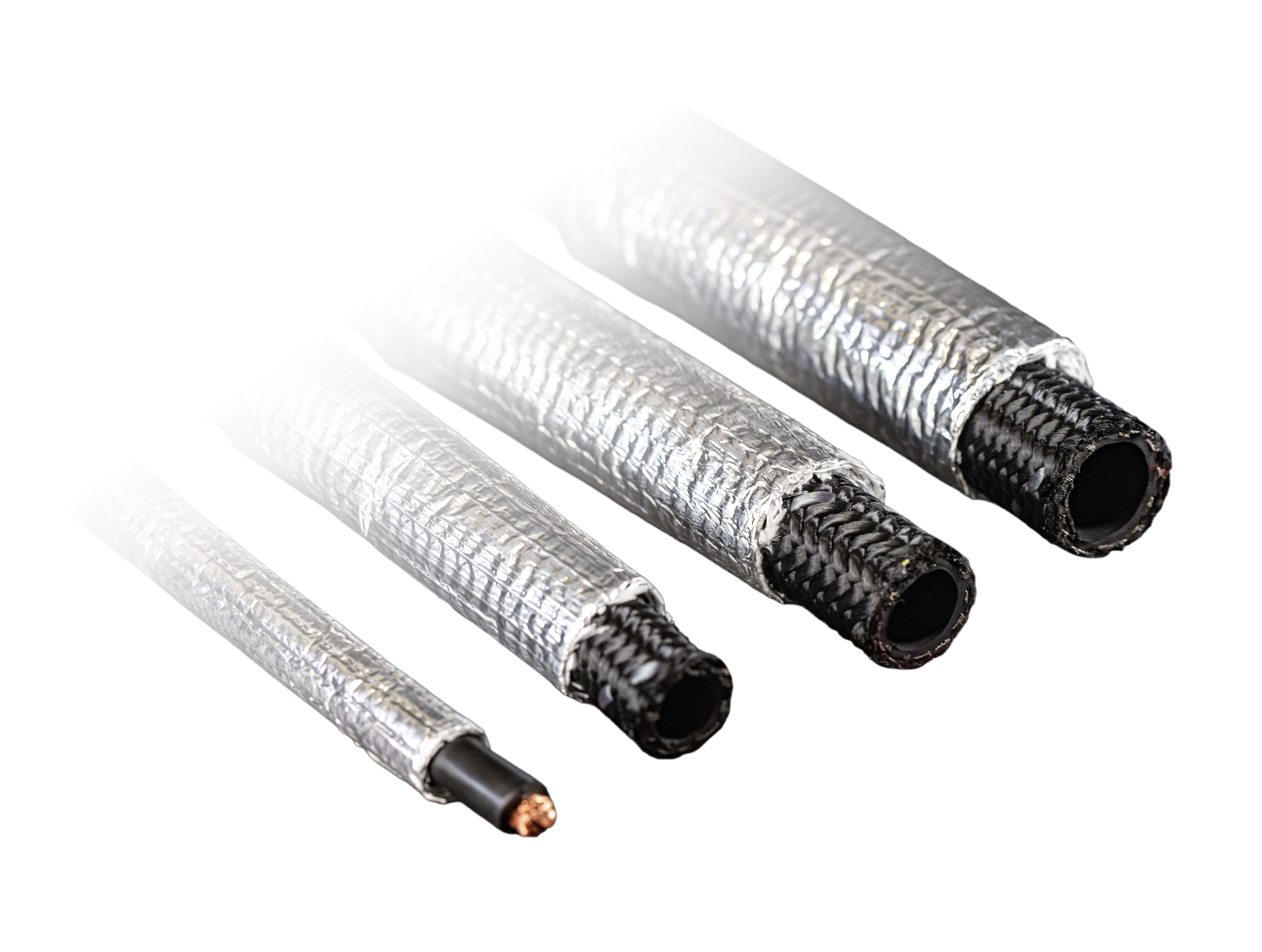
ThermaShield Aluminized Thermal Wrap
Reflect Heat. Prevent Failure. Protect Your Investment.
Because, Horsepower doesn't usually kill parts... heat does.
It’s no surprise that the LT4 creates a tremendous amount of heat, and most of that heat seems to linger in the engine bay, which accelerates heat soaking everything, including the things you DO NOT want to heat soak… like the fluids responsible to feed your beast, and keep her cool. Engine Coolant Hose, Oil Cooler Lines, Heat Exchanger Lines, Fuel System Lines, and Wiring are all subject to the heat radiating from your headers, supercharger, turbo, and more. Add to that the reality that engine bays are getting tighter and tighter, which means critical hoses and wiring are often only inches away from components capable of exceeding 1,400°F surface temperatures. It only takes one overheated fuel line, melted sensor harness, or brittle vacuum hose to end your day.
Which is why investing in Thermal Shield Wrap is such a “no brainer” inexpensive upgrade that can save you thousands of dollars in damaged components, and help prevent you from ruining your track day due to melted components.
Built using Techflex's proven T6 ThermaShield construction, this wrap combines a highly reflective aluminized outer layer with a tightly woven fiberglass insulating core. The aluminized exterior reflects intense radiant heat away from sensitive components, while the fiberglass insulation dramatically slows conductive heat transfer, creating an effective thermal barrier between your engine's hottest components and everything that shouldn't be cooking.
Unlike traditional heat sleeves that require complete disassembly, this wrap features a pre-split wrap-around design with an integrated high-temperature adhesive closure, allowing it to be installed over existing fuel lines, AN hoses, wiring harnesses, vacuum lines, brake lines, clutch lines, transmission cooler lines, and sensor wiring without disconnecting anything.
Whether you're building a 700 horsepower street car or a 1,500+ horsepower track monster, proper heat management isn't optional, it's insurance.
Why We Recommend It
At Griffin Motorsports, we've learned that many reliability problems aren't caused by poor parts, they're caused by excessive heat.
Protecting fuel lines from vapor lock, preventing wiring insulation from becoming brittle, shielding brake and clutch lines from heat soak, and reducing temperatures around sensitive electronics all contribute to a more reliable performance vehicle. When properly installed, can reduce heat transfer into hoses and wiring by 50% or more. It is also resistant to gasoline, oil, hydraulic fluid, engine chemicals, UV exposure, cuts, and abrasion, which makes it perfect for custom fuel lines and oil cooler lines that end up being routed in tight spaces.
This is exactly the type of preventative upgrade we recommend whenever components are routed near:
Long-tube headers or Exhaust manifolds
Turbochargers Turbine / Pluming
Catalytic converters / Exhaust
Brakes / Wheels
Technical Specifications
Genuine Techflex T6 ThermaShield construction
High-temperature adhesive closure strip
Highly reflective aluminized outer surface
Woven fiberglass thermal insulation core
Full pieces come in 4-foot (48") length
Easily trimmed with ordinary scissors
Approximately 0.042" wall thickness
Continuous operating temperature:
-76°F to 491°F (-60°C to 255°C)
Radiant heat exposure:
Up to 1,400°F (760°C)
Fiberglass melt point:
2,048°F (1,120°C)
Halogen-free / RoHS compliant
Split wrap-around design
Split wrap-around design
Perfect For Protecting
Brake or Clutch lines
Fuel lines + AN hoses
Injector + O2 sensor wiring
Transmission + Oil cooler hoses
Wiring harnesses + Battery cables
Air conditioning lines or Sensor wiring
Note from GABE…
Although this product arrives in 4’ lengths we are happy to see it by the foot also. Like you, I hate buying more than I need sometimes. Also see that each size does accommodate a range of hoses size variation. Simple TIP; if the hose / wire is straight, aim for the middle of the range. If the hose / wire had some bend in it, then aim for the smaller side of the range so you’ll have extra material to work with. Also; I highly recommend purchasing some of this DEI Cool Tape to seal the ends, and wrap irregular shaped fittings / hoses. You’ll thank me later.
ThermaShield Aluminized Thermal Wrap
Built using Techflex's proven T6 ThermaShield construction, this wrap combines a highly reflective aluminized outer layer with a tightly woven fiberglass insulating core. The aluminized exterior reflects intense radiant heat away from sensitive components, while the fiberglass insulation dramatically slows conductive heat transfer, creating an effective thermal barrier between your engine's hottest components and everything that shouldn't be cooking.
from $1.95
Why Radiant Heat Is a Problem in High-Performance Cars
Most enthusiasts think about heat in terms of coolant temperature, oil temperature, or intake-air temperature.
But those measurements only tell part of the story.
A significant amount of thermal energy inside the engine compartment is transferred through radiation from extremely hot surfaces. Exhaust manifolds, long-tube headers, catalytic converters, turbine housings, and exhaust tubing radiate energy outward into everything surrounding them.
A component doesn't have to physically touch a header to become hot.
A fuel hose routed several inches away can absorb radiant energy. So can an oil cooler line, coolant hose, wiring harness, electrical connector, brake line, or sensor lead.
Over time, repeated heat exposure can accelerate deterioration of rubber, plastics, wiring insulation, connectors, and other temperature-sensitive materials. Fluids traveling through exposed lines can also absorb unwanted heat before they ever reach the component they're intended to cool, lubricate, or supply.
Managing those localized heat sources is an important—and frequently overlooked—part of building a reliable performance car.
How ThermaShield Aluminum Thermal Wrap Reduces Heat Transfer
ThermaShield aluminum thermal wrap attacks the problem using two different thermal-management strategies.
The outer aluminum-laminated surface is highly reflective and helps reject radiant energy coming from nearby hot components.
Behind that reflective surface is a fiberglass insulating layer that provides additional resistance to heat moving through the wrap and into the protected component.
According to Techflex, when properly applied, T6 ThermaShield can reduce heat transmission from nearby hot pipes and engine components into hoses or wiring harnesses by up to 50% or more.
That doesn't mean the protected component becomes immune to heat. The actual reduction depends on the temperature of the heat source, distance from that source, airflow, installation, and other environmental conditions.
What the wrap provides is an additional thermal barrier between extreme engine-bay temperatures and components that benefit from staying cooler.
ThermaShield Aluminized Heat Wrap Without Removing Your Hoses
One of the biggest advantages of ThermaShield aluminized heat wrap is how easily it can be added to an existing vehicle.
Traditional closed thermal sleeves often need to be slid over a hose or wire, which means disconnecting fittings, draining fluids, removing connectors, or partially disassembling the vehicle.
ThermaShield T6 uses a preformed split construction.
The material opens around the existing hose, cable, or wiring harness and then closes using an integrated high-temperature adhesive strip.
That makes it particularly useful when adding thermal protection to a completed build—or when you discover after installation that an oil line, fuel hose, coolant hose, or wiring harness ended up closer to a heat source than you'd like.
Sometimes the smartest solution isn't rerouting half the engine bay.
It's simply adding the right barrier between the component and the heat.
ThermaShield Thermal Wrap for Fuel, Oil and Coolant Lines
Fluid temperature matters throughout a performance vehicle.
Fuel lines routed through a hot engine bay can absorb energy from surrounding exhaust components. Oil leaving a cooler can begin absorbing engine-bay heat again before returning to the engine. Intercooler coolant traveling through exposed hoses can encounter the same problem.
This is why ThermaShield thermal wrap is particularly useful around custom AN plumbing and performance cooling systems.
When installing a high-capacity ZL1 Triple Heat Exchanger Set, for example, considerable effort goes into increasing the intercooler system's ability to reject heat. Protecting coolant lines where they pass near significant radiant heat sources helps preserve the work the heat exchangers are doing rather than unnecessarily exposing those lines to additional thermal energy.
The same principle applies throughout a complete collection of ZL1 cooling mods.
Improving heat rejection is important.
Preventing unnecessary heat absorption is important too.
Protecting Oil Cooler Lines From Radiant Heat
Oil cooling provides another excellent example.
A properly designed oil cooler lowers the temperature of engine oil before sending it back toward the engine. But depending on hose routing, those lines may pass through areas exposed to considerable exhaust and engine-bay heat.
The GMS Stage II Oil Cooler Package uses large -12AN plumbing to provide substantial oil-flow capacity for high-performance and track-driven LT4 applications. When routing those lines through a tightly packaged Camaro engine bay, protecting sections exposed to significant radiant heat can provide another layer of thermal management.
ThermaShield can be wrapped around existing oil cooler hoses without disconnecting the AN fittings, making it particularly convenient for completed oil-cooler installations.
That same approach applies to transmission cooler lines, powertrain plumbing, and other fluid circuits routed through high-temperature areas.
ThermaShield Heat Wrap for Wiring and Sensitive Electronics
Fluids aren't the only things worth protecting.
Modern performance cars contain an enormous amount of wiring, sensors, modules, connectors, and data equipment inside the engine compartment. Modifying the vehicle can add even more.
Injector wiring, oxygen-sensor leads, sensor harnesses, battery cables, and aftermarket gauge wiring may all pass through areas exposed to significant heat.
ThermaShield heat wrap provides a convenient way to add protection to these components without depinning connectors or disassembling the harness.
This becomes increasingly valuable as enthusiasts add more instrumentation. Proper ZL1 gauges can provide valuable information about oil temperature, intake-air temperature, fuel pressure, coolant temperature, and other parameters—but the wiring and sensors collecting that information still have to survive the environment in which they're installed.
Protecting the measurement system is part of building a reliable monitoring system.
Where Should ThermaShield Aluminized Thermal Wrap Be Used?
ThermaShield is particularly useful anywhere a temperature-sensitive line or harness passes near a major radiant heat source.
Common applications include:
Fuel lines and AN hoses
Engine oil cooler hoses
Supercharger heat-exchanger hoses
Transmission cooler lines
Brake and clutch lines
Injector wiring
Oxygen-sensor wiring
Sensor harnesses
Battery cables
Vacuum lines
Air-conditioning lines
Electrical harnesses
Areas near long-tube headers, exhaust manifolds, catalytic converters, turbocharger turbine housings, exhaust piping, and other high-temperature components deserve particular attention.
The objective isn't to wrap everything under the hood.
It's to identify areas where heat source + proximity + sensitive component create unnecessary risk.
Griffin Motorsports Insight
This is one of those inexpensive products we think gets overlooked because it doesn't make horsepower.
But reliability isn't only about buying stronger engine parts.
When we're routing fuel lines, oil cooler hoses, heat-exchanger plumbing, or wiring through a modified engine bay, we look at what's next to them. If a $20 section of thermal protection can reduce the amount of heat reaching an expensive hose, sensor harness, or fluid circuit, that's cheap insurance.
We especially like ThermaShield because it can be added after the car is already assembled. You don't have to disconnect an AN hose full of oil or coolant simply to slide a conventional sleeve over it.
Open it. Wrap it. Seal it.
Sometimes good engineering really is that simple.
ThermaShield T6 Technical Specifications
ThermaShield Aluminized Thermal Wrap features:
Genuine Techflex T6 ThermaShield construction
Aluminum-laminated fiberglass material
Highly reflective aluminized outer surface
Fiberglass insulating layer
Split self-wrapping construction
Integrated high-temperature adhesive closure
Approximately 0.042-inch wall thickness
Continuous operating temperature from -76°F to 491°F (-60°C to 255°C)
Radiant heat exposure capability up to 1,400°F (760°C)
Fiberglass melt point of approximately 2,048°F (1,120°C)
Resistant to gasoline and common engine chemicals
Cut and abrasion resistant
Easily trimmed with scissors
Available in multiple diameters for different hose and harness sizes
Full factory pieces supplied in 4-foot lengths
Available from Griffin Motorsports by the foot
Choosing the Correct ThermaShield Wrap Size
Choosing the correct size is important because ThermaShield needs enough overlap to close securely around the component.
For relatively straight hoses and wiring, select a size that places the outside diameter of the component comfortably within the specified range rather than at the absolute limit.
Curved hoses and tight bends require additional material around the outside radius. For those applications, Griffin Motorsports recommends sizing with enough additional overlap to allow the ThermaShield to follow the bend without pulling the adhesive seam apart.
Note From Gabe
ThermaShield comes from the manufacturer in 4-foot lengths, but we're happy to sell it by the foot because I hate buying three feet of something when I only need one.
For straight hose or wiring runs, aim somewhere near the middle of the recommended sizing range. If you're wrapping something with bends, stay toward the smaller side of the stated component-size range so you have additional wrap available to accommodate the outside of the curve.
I also recommend using heat-reflective aluminum tape to finish the ends and deal with irregularly shaped fittings or transitions. It makes the finished installation considerably cleaner.
Building a Complete Heat-Management Strategy
ThermaShield isn't a replacement for an upgraded radiator, heat exchanger, oil cooler, or properly designed airflow system.
It solves a different problem.
A ZL1 Triple Heat Exchanger Set increases the intercooler system's ability to reject thermal energy.
A GMS Stage II Oil Cooler Package increases the engine-oil system's ability to reject heat during sustained high-load operation.
Other ZL1 cooling mods address coolant flow, thermal mass, charge-air temperature, and additional heat-rejection capacity.
ThermaShield helps protect the hoses, lines, and wiring traveling between those systems from absorbing heat you never wanted them to have in the first place.
A complete thermal-management strategy therefore isn't just about getting heat out.
It's also about controlling where that heat is allowed to go.
Frequently Asked Questions
-
ThermaShield T6 uses an aluminum-laminated fiberglass construction. The reflective aluminum exterior helps reject radiant energy while the fiberglass backing provides an insulating layer between the heat source and the protected component.
-
Techflex states that properly applied T6 ThermaShield can reduce heat transmission from nearby hot pipes or engine components into protected hoses and harnesses by up to 50% or more.
Actual results depend on the heat source, distance, airflow, installation, and operating environment.
-
The T6 material is rated for continuous operating temperatures from approximately -76°F to 491°F (-60°C to 255°C) and radiant heat exposure up to approximately 1,400°F (760°C). Its fiberglass material has a melt point of approximately 2,048°F (1,120°C).
-
No. That's one of the primary advantages of the T6 design.
Its split wrap-around construction allows it to be installed over many existing hoses, lines, wires, and harnesses without disconnecting them first.
-
Yes. Techflex lists the material as resistant to gasoline and engine chemicals, making it well suited to protecting properly routed fuel lines and AN hoses from nearby radiant heat.
It should be used as thermal protection, not as a substitute for proper fuel-line routing and clearance from exhaust components.
-
Yes. Oil cooler hoses are one of our favorite applications, particularly where an AN line must pass through an area exposed to radiant heat from the engine or exhaust system.
-
No.
Header wrap is generally applied directly to the hot exhaust component to contain heat at its source. ThermaShield is primarily intended to protect the component near the heat source by reflecting radiant energy and adding insulation.
The two products address the same thermal problem from opposite sides.
-
Yes. The T6 product was specifically designed to protect wire bundles, cables, hoses, and lines from nearby heat-generating components.
-
Yes. Sections of heat-exchanger or intercooler coolant hose that pass near significant radiant heat sources can be protected with ThermaShield.
This can be especially useful on modified cooling systems with additional plumbing.
-
Measure the total length of each hose, wire, or harness you intend to protect and add a little extra for bends, overlaps, trimming, and finishing the ends.
Griffin Motorsports sells ThermaShield by the foot so you don't have to purchase significantly more material than your installation requires.
Final Considerations
ThermaShield Aluminized Thermal Wrap won't add horsepower to your Camaro.
It won't lower your pulley ratio, increase coolant flow, or make a larger heat exchanger magically reject more heat.
What it can do is prevent some of the enormous amount of thermal energy already inside a high-performance engine bay from reaching components that don't need it.
Fuel lines. Oil hoses. Coolant plumbing. Wiring. Sensors. Brake lines.
Those aren't glamorous components until one fails.
For us, thermal protection is inexpensive insurance—and because ThermaShield can be wrapped around components already installed on the vehicle, there are very few excuses for leaving an important hose or harness cooking next to a major heat source.
Reflect Heat. Prevent Failure. Protect Your Investment.