
LT5 Belt Tensioner Upgrade for Camaro ZL1 and LT4 Engines
Adding boost to the LT4 sounds simple: spin the supercharger faster and make more power. But as upper pulleys get smaller, lower pulleys get larger, and supercharger speed increases, considerably more is being asked of the belt-drive system responsible for turning the blower.
As you may be finding out, belt slip on a modified LT4 can still occur even when using all of the best parts available (ZPE Griptec upper pulley, Larger lower pulley, and the Gates HD Green Belts) This is exactly the issue I had, even after replacing my upper pulley and a fresh green belt. With only 770rwhp, I was still seeing alot of boost drop and belt slip on my HPT datalogs, with the smallest belt I could fit.
The solution? We have two depending on your power level.
The most cost effective solution is upgrading to the GM LT5 tensioner.
Why? Because the the OEM LT5 tensioner provides approx. 30% more belt tension and has approx. 12% more belt length take-up. This helps tremendously with belt slip, on higher HP builds.
Keep in mind, despite the LT5 only making 100hp more than the LT4, GM realized even that small of a bump in HP/TQ not only required 30% more belt tension, but it required an 11-rib belt which also provided 37% more belt surface area to prevent slipping. That context alone should help us understand why so many LT4 owners with even light mods are already experiencing belt slip with the LT4’s 8-rib system.
Luckily, the solution is pretty straight foward, and one that has already passed through the brain trust with our friends at Too High PSI. They have already created the perfect billet adapter bracket for the Camaro/CTSV LT1/LT4 users, allowing us to bolt the OEM LT5 Tensioner with no fuss, onto a stronger than OEM bracket. The Too High PSI Supercharger Belt Tensioner Bracket is not only a work of art, but it ensures your supercharger maintains full boost throughout your entire run - giving you the competitive edge you need, to keep all that power where it belongs… the pavement.
We think this is a great option for builds from 650-800rwhp.
Making more power than that? Then I suggest checking out our complete 10-rib upgrade package for those making 800rwhp or more found HERE.
The TooHighPsi billet tensioner bracket + LT5 Tensioner offers:
48% larger tensioner shaft and bearings for robust belt control.
Beautiful machined billet finish to match other accessories.
Up to 30% more belt tension than stock tensioner.
Stiffer bracket design for higher HP builds.
12% more belt length take-up (travel).
Designed for the OEM LT5 tensioner.
Installation is simple, and many people have shared they were able to use the same size belt as before the upgrade.
Whats in the box;
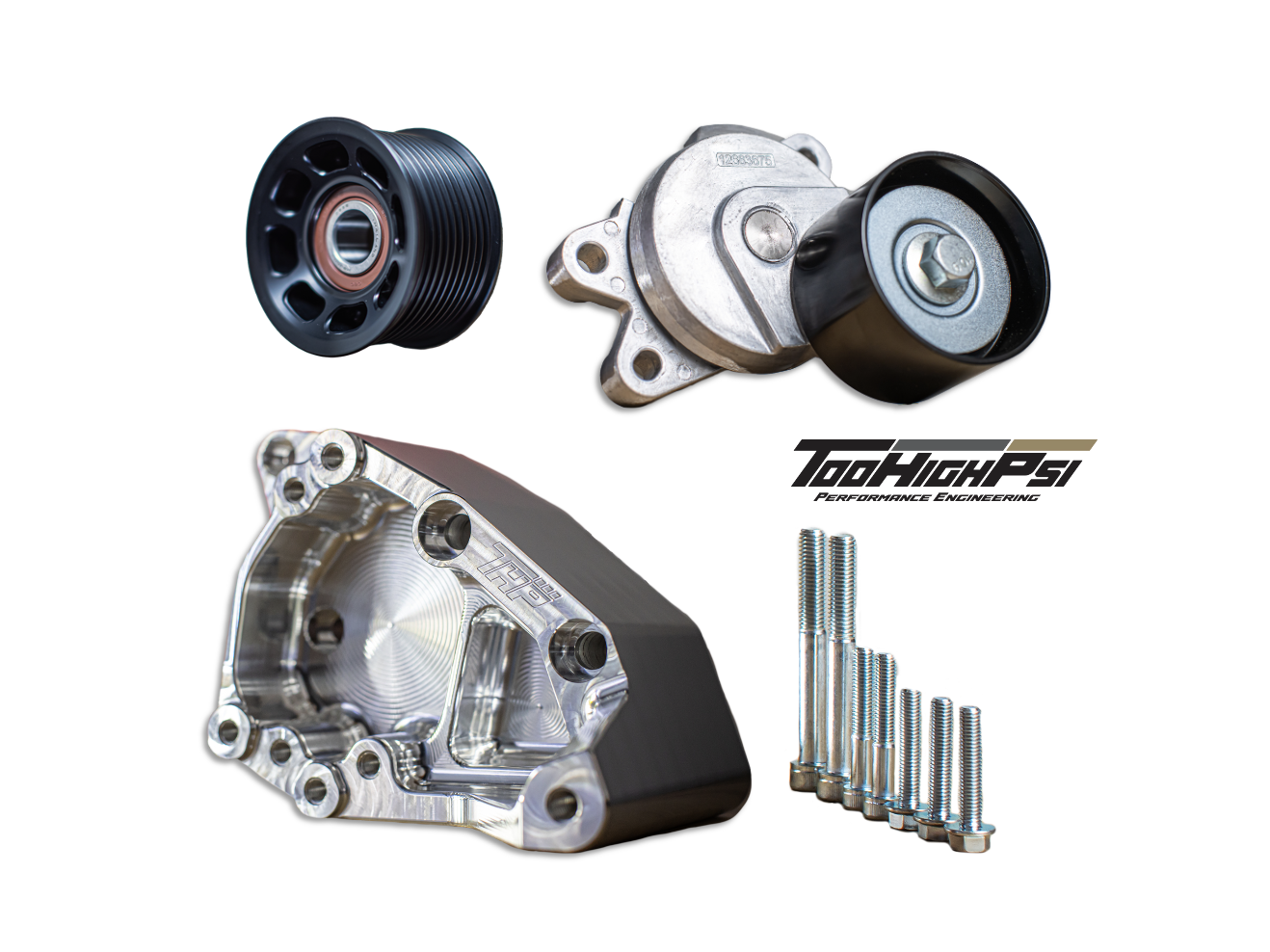
(1) Genuine GM LT5 Belt Tensioner OEM # 12683675.
(1) THPSI 10-rib black anodized black idler pulley.
(1) THPSI Billet Adapter Bracket + Hardware.
Fitment: All LT4 Camaros + CTS.V’s + LT1 users who have upgraded to the LT4 supercharger. Any questions? email us at info@griffin-motorsports.com
LT5 Belt Tensioner + Billet Adapter Bracket
Keep in mind, despite the LT5 only making 100hp more than the LT4, GM realized even that small of a bump in HP/TQ not only required 30% more belt tension, but it required an 11-rib belt which also provided 37% more belt surface area to prevent slipping. That context alone should help us understand why so many LT4 owners with even light mods are already experiencing belt slip with the LT4’s 8-rib system…
$725.00 $755.00
Why Modified LT4 Engines Experience Supercharger Belt Slip
The factory LT4 uses an 8-rib supercharger drive system designed around the original supercharger speed and power requirements of the engine. At factory power levels, it does its job remarkably well.
The problem begins when we ask it to do substantially more.
A smaller upper pulley increases supercharger speed while reducing the diameter of the pulley the belt must grip. A larger lower pulley also increases blower speed and belt load. Combine the two on a modified LT4 and the belt must transmit considerably more power to the supercharger while maintaining consistent contact with the pulleys throughout the RPM range.
As load increases, the belt can begin slipping across the supercharger pulley. When that happens, supercharger speed falls relative to engine speed and the boost you expected from the pulley combination never fully reaches the engine.
That is why a modified LT4 can have an excellent pulley, a quality belt, and apparently adequate belt wrap, and still experience belt slip.
LT5 Drive Belt Tensioner vs. Factory LT4 Tensioner
The LT5 was developed for considerably greater factory output than the LT4, and GM increased the capability of its supercharger drive system accordingly.
The LT5 drive belt tensioner provides approximately 30% more belt tension than the factory LT4 unit along with approximately 12% more belt-length take-up. Its tensioner shaft and bearing assembly are also approximately 48% larger, providing a more robust foundation for controlling the belt at high supercharger speeds.
That additional tension and travel help the belt remain engaged with the pulley as engine speed and supercharger load increase.
The goal isn't simply to make the belt tighter. It's to maintain better belt control throughout the operating range.
For modified LT4 applications that are beginning to overwhelm the factory tensioner but don't yet require a complete belt-drive conversion, the LT5 tensioner represents an effective middle ground.
Why the LT5 Belt Tensioner Requires a Billet Adapter Bracket
The Genuine GM LT5 engine belt tensioner does not bolt directly onto the factory Camaro ZL1 or CTS-V LT4 tensioner bracket.
That's where the Too High PSI billet adapter comes in.
The precision-machined billet bracket adapts the OEM LT5 tensioner to compatible LT4 applications while providing a stiffer mounting structure designed for the additional loads found in modified supercharger combinations.
Rather than attempting to reinvent the tensioner itself, this package takes advantage of a Genuine GM component engineered for a higher-output supercharged application and combines it with the hardware necessary to integrate it into the LT4 belt drive.
The result is a clean, robust solution that looks at home in the engine bay while significantly increasing belt-control capability.
How an LT5 Serpentine Belt Tensioner Helps Maintain Boost
Boost is only useful if the supercharger can maintain its intended speed.
When a belt slips, the crankshaft continues accelerating while the supercharger pulley momentarily fails to follow at the commanded ratio. The result can appear in a datalog as boost that peaks and then falls away unexpectedly toward the upper end of the RPM range.
This can easily be mistaken for an airflow issue, bypass-valve problem, or another mechanical limitation.
An upgraded LT5 serpentine belt tensioner helps address one potential source of that problem by increasing belt tension and giving the tensioner greater travel to maintain control as the belt moves dynamically through the RPM range.
This becomes particularly valuable on LT4 combinations using smaller upper pulleys, overdrive lower pulleys, ported superchargers, and other modifications designed to increase blower speed.
For cars operating at these power levels, good data becomes increasingly important as well. Proper ZL1 gauges can help drivers monitor boost, temperatures, fuel-system data, and other parameters that provide a clearer picture of how the complete vehicle is performing.
When Is the LT5 Belt Tensioner Upgrade Enough?
Not every modified LT4 needs a complete 10-rib conversion.
For street and street/track combinations that are beginning to experience belt slip on the factory 8-rib drive, the LT5 tensioner conversion can be a cost-effective way to significantly improve belt control while retaining the existing belt-drive architecture.
At Griffin Motorsports, we generally view the LT5 tensioner conversion as an excellent first step for mildly to moderately modified LT4 combinations where the factory tensioner has become the weak link.
The exact point at which an LT4 overwhelms its belt drive cannot be defined by horsepower alone. Upper pulley diameter, lower pulley diameter, supercharger speed, belt length, belt wrap, tensioner position, supercharger type, and engine RPM all influence the amount of load placed on the drive system.
That's why we recommend diagnosing the actual combination rather than automatically assuming every modified ZL1 needs the most aggressive belt-drive package available.
When Should You Upgrade to a 10-Rib Supercharger Belt Drive?
There is a point where adding tension to an 8-rib belt is no longer the complete answer.
As supercharger speed and transmitted load continue increasing, belt surface area becomes increasingly important. A wider belt provides additional contact area across the pulley and greater capacity to transfer torque from the crankshaft to the supercharger.
For more aggressive LT4 combinations—particularly cars running substantial upper and lower pulley changes, high supercharger speeds, or combinations that continue experiencing belt slip despite improved tension—we recommend considering the complete Griffin Motorsports 10-Rib Supercharger Belt Drive Package.
Moving from an 8-rib to a 10-rib belt provides approximately 25% more belt width and available pulley contact area. Combined with the increased tension and travel of the LT5 tensioner, the wider drive system attacks belt slip from both sides: greater tension and greater belt engagement.
The LT5 tensioner isn't therefore replaced by the 10-rib upgrade. It becomes an important part of the complete system.
Why the ATI Damper Matters in a Complete LT4 Belt Drive
Once the supercharger drive is upgraded, the crankshaft side of the system deserves the same attention.
A quality damper provides the foundation for the lower supercharger drive while also performing the critical job of controlling crankshaft torsional vibration. For customers moving into more aggressive pulley combinations or our complete 10-rib system, the ATI Performance Super Damper Upgrade provides a proven foundation for the lower drive assembly.
This is another example of why Griffin Motorsports approaches LT4 modifications as systems rather than individual parts. The upper pulley, belt, tensioner, idlers, lower pulley, and damper all have to work together to reliably transmit power from the crankshaft to the supercharger.
Fixing one weak point while ignoring another can simply move the problem somewhere else.
Griffin Motorsports Insight
We learned this one firsthand.
On our own LT4 combination, we were seeing significant boost drop in HP Tuners datalogs at approximately 770 RWHP, even with a GripTec upper pulley, a fresh Gates HD belt, and the shortest belt we could reasonably install.
The problem wasn't that we needed another belt. We needed better belt control.
Moving to the LT5 tensioner gave us access to approximately 30% more tension and 12% more take-up travel, addressing an area the factory LT4 tensioner simply wasn't designed to handle at elevated supercharger speeds.
That's why we view this conversion as more than another billet engine-bay accessory. If your datalogs show the blower isn't maintaining the boost your pulley combination should produce, the belt drive deserves to be investigated before chasing the problem somewhere else.
LT5 Belt Tensioner + Billet Adapter Bracket Features
This Griffin Motorsports package includes:
Genuine GM LT5 Supercharger Belt Tensioner — GM #12683675
Too High PSI billet LT4-to-LT5 tensioner adapter bracket
Too High PSI black-anodized idler pulley
Installation hardware
Approximately 30% more belt tension than the factory LT4 tensioner
Approximately 12% more belt take-up travel
Approximately 48% larger tensioner shaft and bearing assembly
Stiffer billet bracket design for modified LT4 applications
Compatible with Camaro ZL1, CTS-V, and applicable LT1-to-LT4 supercharger conversions
Frequently Asked Questions
-
The LT5 tensioner provides greater belt tension, additional take-up travel, and a substantially larger shaft and bearing assembly than the factory LT4 tensioner. These improvements help maintain better belt control as supercharger speed and belt load increase.
-
No. The Genuine GM LT5 tensioner does not directly bolt onto the factory Camaro ZL1 LT4 tensioner bracket. The Too High PSI billet adapter bracket included with this package allows the LT5 tensioner to be installed on compatible LT4 applications.
-
Common signs can include boost dropping unexpectedly at high RPM, inconsistent boost between pulls, excessive belt dust, premature belt wear, or datalogs showing less boost than expected from the installed pulley combination.
Because other conditions can also cause boost loss, datalogging is one of the best ways to begin diagnosing the problem.
-
Not by itself. A tensioner doesn't create additional engine airflow or horsepower. Its job is to help the belt maintain the intended supercharger speed. If your existing system is experiencing belt slip, correcting that slip can allow the engine to recover boost and performance that was previously being lost.
-
In many installations, customers have been able to retain the same belt size. However, belt length depends on the complete pulley combination and tensioner position, so belt fitment should always be verified during installation.
-
Not necessarily. The LT5 tensioner conversion can be an excellent solution for modified LT4s that need greater belt control but haven't overwhelmed the capacity of the complete 8-rib system.
If the car continues experiencing belt slip at high supercharger speeds, or the build is moving toward a considerably more aggressive combination, stepping up to a 10-rib system provides additional belt width and pulley contact area.
-
No. The LT5 tensioner complements the 10-rib conversion. Griffin Motorsports' complete 10-rib package uses the increased tension and travel of the LT5 tensioner along with the additional contact area of the wider belt.
-
The crankshaft damper provides the mounting foundation for many aftermarket lower supercharger pulley systems while also controlling crankshaft torsional vibration. An ATI Performance Super Damper is therefore a logical supporting upgrade when building a more aggressive LT4 supercharger drive.
-
No. Belt tension is only one part of the system. Belt condition, pulley diameter, pulley alignment, belt wrap, belt length, supercharger speed, and available belt surface area all affect belt traction. Extremely aggressive combinations may require a wider belt-drive system rather than additional tension alone.
-
The package is intended for LT4-powered Camaro applications, compatible CTS-V applications, and LT1 applications that have been converted to an LT4 supercharger setup. Always verify your exact vehicle and supercharger configuration before ordering.
Final Considerations
Supercharger belt slip is easy to overlook because the engine can continue running perfectly well while the blower quietly loses speed at the top of the pull.
The LT5 belt tensioner addresses one of the fundamental limitations of the factory LT4 belt drive by providing more tension, greater take-up travel, and a significantly more robust tensioner assembly. Combined with the Too High PSI billet adapter bracket, it provides Camaro ZL1 and LT4 owners with a clean way to bring that additional belt-control capability to the factory-style drive system.
For moderately modified combinations, it may be exactly the upgrade needed to bring belt slip under control. For more aggressive builds, it also provides the foundation for stepping into a complete 10-rib supercharger drive.
The goal isn't simply to make the belt tighter. It's to keep the supercharger spinning at the speed you built the engine to deliver.