
CWA 150 Upgraded Heat Exchanger Pump for Camaro ZL1
Heat is one of the biggest enemies of consistent performance on the supercharged Camaro ZL1. Every time the LT4's supercharger compresses air, it adds heat. The intercooler system is responsible for removing as much of that heat as possible before the air enters the engine, and accomplishing that requires more than simply installing a larger heat exchanger.
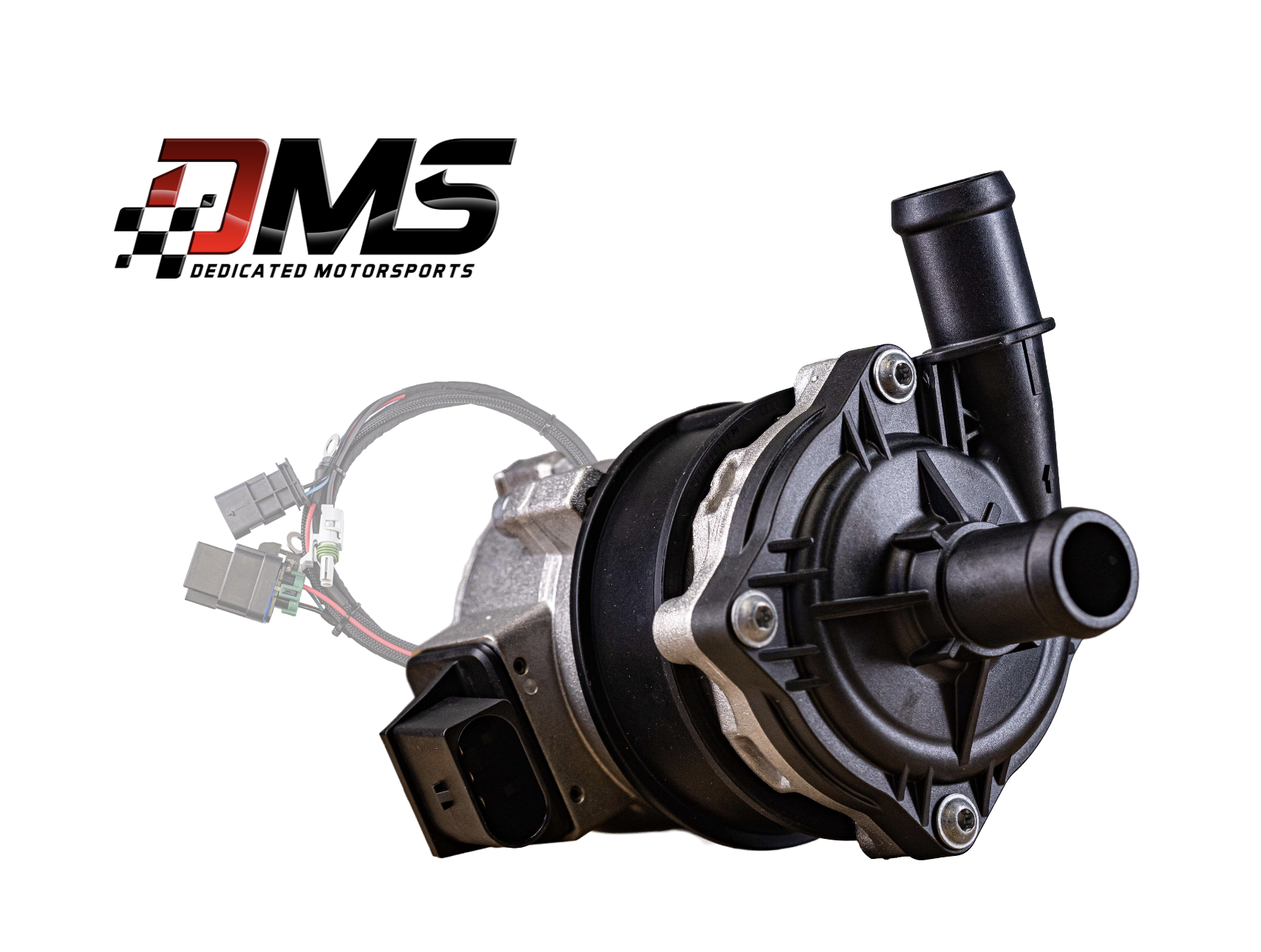
DMS - CWA150 High-Flow Heat Exchanger Pump Kit
Increase Coolant Flow. Improve Heat Transfer. Keep Your LT4 Cooler Under Boost.
When it comes to intercooler performance, most enthusiasts focus on larger heat exchangers, bigger reservoirs, or improved intercooler bricks. While all of those upgrades play an important role, they're only as effective as the amount of coolant flowing through the system.
Which is why we have been so laser focused in removing restrictions within the HX system and with all of our efforts were able to buy our GPM flow rate from 2.8 to 5.4 with our Stage.III Supercharger Cooling System, that works hard to maximize the OEM pump.
We’ll after increasing our GPM flow rate by approximately, 92% we knew there was more to be had, and wanted more flow to help utilize our NEW Upgraded CSF Intercooler Bricks for the LT4 1.7L supercharger.
Rather that creating our own kit, we decided to utilize another cool solution from our friends at Dedicated Motorsports, who already had the perfect plug and play wiring harness for the CWA150 High-Flow Heat Exchanger Pump. This kit completely replaces the factory Bosch intercooler pump with a significantly higher-capacity electric pump designed to circulate substantially more coolant throughout your supercharger cooling system. By increasing coolant flow, the CWA150 allows heat to be transferred away from the intercooler bricks more quickly, helping maintain more consistent intake air temperatures during repeated acceleration, spirited street driving, road course sessions, and drag strip passes.
During testing on our own Griffin Motorsports Camaro ZL1, we measured an increase in intercooler coolant flow from approximately 5.4 GPM with the factory pump to nearly 8.0 GPM using the CWA150. While additional testing is still underway to quantify the effect on intake air temperatures, the increase in coolant circulation is substantial and supports the same engineering principle found throughout every liquid cooling system: moving more coolant through the heat exchanger allows the system to remove heat more effectively.
Why Coolant Flow Matters
A heat exchanger doesn't create cooling, it transfers heat.
The faster coolant can circulate between the intercooler bricks and the heat exchanger, the more opportunities it has to shed heat before returning to the supercharger. Increasing coolant flow helps reduce localized hot spots, improves overall system efficiency, and allows the cooling system to recover more quickly between hard pulls.
For high-horsepower LT4 combinations producing significant boost, maintaining coolant circulation becomes increasingly important as heat load continues to rise.
OEM Pump vs. CWA150
The factory Bosch intercooler pump was engineered to support the cooling requirements of a stock LT4 engine, where drivability, cost, packaging, and long-term durability all had to be balanced. For stock and lightly modified vehicles, it performs its job well.
However, as supercharger boost increases, larger blower upgrades are installed, or the vehicle is subjected to repeated wide-open-throttle operation, the amount of heat generated by the intercooler system increases dramatically. At that point, increasing coolant flow becomes another valuable tool for managing heat.
The CWA150 provides substantially greater coolant circulation than the factory pump while integrating cleanly into the factory cooling system. Because the pump draws additional electrical current, Dedicated Motorsports includes a plug-and-play heavy-duty wiring harness featuring larger gauge wiring to ensure reliable power delivery under increased load. Installation remains straightforward while providing the electrical capacity needed to support the higher-performance pump.
Features
High-flow CWA150 electric intercooler pump
Significantly increased coolant circulation flow
Faster heat exchanger recovery between pulls
Plug-and-play custom wiring harness for an easy installation
Excellent upgrade for high-boost and track-driven LT4 applications
Compatible with most aftermarket heat exchangers and reservoirs
Griffin Motorsports Insight
Many enthusiasts assume a larger heat exchanger alone will solve rising intake temperatures. In reality, every liquid cooling system depends on three things working together: heat exchanger capacity, coolant volume, and coolant flow. Improving only one of those areas leaves performance on the table. The CWA150 complements larger heat exchangers and reservoirs by helping move coolant through the entire system more efficiently, allowing each component to perform closer to its full potential.
Perfect for those who aim for maximum cooling efficiency!
Why Buy From Griffin Motorsports?
At Griffin Motorsports, we don't recommend products simply because they're popular, we recommend components that make engineering sense. Every cooling upgrade we offer is selected to improve the overall efficiency of the complete system, and whenever possible, we validate those improvements with real-world testing on our own vehicles.
The Dedicated Motorsports CWA150 High-Flow Pump is another example of that philosophy: a simple upgrade that addresses one of the most important factors in intercooler performance, and coolant circulation.
FITMENT: We only keep the wiring harness in stock for the 6th Gen. Camaro. Need one for a 5th Gen? CTS.V? or C7 ZO6? Then email us at Gabe@Griffin-Motorsports.com so we can order you the correct harness.
What’s in the box?
CWA 150 Aluminum Body Pump
Plug and play wiring harness with fuse block
Installation kit provided by GMS that includes longer bolts, 12” Zip Ties and aluminum spacers to allow for installation onto the OEM bracket with OEM rubber isolator.
CWA 150 Upgraded Heat Exchanger Pump
When it comes to intercooler performance, most enthusiasts focus on larger heat exchangers, bigger reservoirs, or improved intercooler bricks. While all of those upgrades play an important role, they're only as effective as the amount of coolant flowing through the system.
Which is why we have been so laser focused in removing restrictions within the HX system and with all of our efforts were able to buy our GPM flow rate from 2.8 to 5.4 with our Stage.III Supercharger Cooling System, that works hard to maximize the OEM pump…
$550.00
Why Coolant Flow Matters in the Camaro ZL1 Intercooler System
The LT4 uses a liquid-to-air intercooling system to remove heat from the compressed air exiting the supercharger.
Coolant absorbs heat as it passes through the intercooler bricks inside the supercharger, then travels forward through the heat exchangers where that energy is transferred into the outside air. The cooled fluid then returns to the supercharger and repeats the process.
For that heat-transfer cycle to work effectively, coolant must continuously circulate through the entire system.
As restrictions increase, coolant flow can decrease. Small-diameter hoses, restrictive fittings, factory heat exchangers, intercooler passages, and additional components all create resistance that the pump must overcome.
This is why improving ZL1 cooling mods isn't simply a matter of adding the largest heat exchanger possible. Surface area, coolant volume, system restriction, and coolant flow all have to work together.
CWA 150 Heat Exchanger Pump: Designed to Work Against Higher System Resistance
The CWA 150 heat exchanger pump is particularly interesting because it isn't simply designed to produce an impressive unrestricted flow number.
Pierburg developed the CWA150 as the higher-pressure variant of the CWA100-3. Its impeller and pump housing were redesigned specifically to operate against greater differential pressure.
The CWA150 is rated for approximately 25 liters per minute at 1.40 bar differential pressure and approximately 40 liters per minute at 0.80 bar. It operates from 9–16 volts, draws up to 15 amps, and uses a brushless electric motor with integrated speed control.
That higher differential-pressure capability is valuable in an automotive intercooler circuit because the pump isn't moving coolant through an unrestricted hose. It's pushing coolant through intercooler bricks, fittings, hoses, heat exchangers, and every other restriction in the system.
The goal isn't simply to install a "bigger pump."
The goal is to maintain useful coolant flow through the complete cooling circuit.
Griffin Motorsports CWA150 Coolant Flow Testing
Rather than relying exclusively on manufacturer pump specifications, Griffin Motorsports wanted to know what the CWA150 would actually do when installed in a modified Camaro ZL1 cooling system.
So we measured it.
With our previous heat exchanger pump installed, our test vehicle circulated approximately:
5.4 GPM
After installing the CWA150, measured coolant flow increased to approximately:
8.0 GPM
That's an increase of approximately:
48% in measured coolant flow.
That's a substantial change, but it's important to understand exactly what that number means.
It does not mean intake-air temperatures will automatically drop by 48%. Coolant temperature, ambient temperature, heat-exchanger efficiency, intercooler-brick efficiency, supercharger heat generation, vehicle speed, coolant volume, and the amount of time the engine remains under load all influence final intake-air temperatures.
What our testing demonstrates is much simpler: in our combination, changing the pump substantially increased the amount of coolant circulating through the intercooler system.
For a cooling system, that's valuable data.
Why a CWA150 Upgraded Heat Exchanger Pump Works Best as Part of a Complete System
Increasing pump capacity is only useful if the rest of the system allows the additional coolant to move.
Think of the intercooler circuit as a closed loop. Installing a more capable pump while retaining significant restrictions throughout that loop can limit how much of the pump's additional capability actually reaches the intercooler bricks.
That's why Griffin Motorsports approaches supercharger cooling as a complete system rather than a collection of unrelated components.
Our CSF Triple Heat Exchanger Package addresses the heat-rejection side of the system with a larger DMS-designed, CSF-built main heat exchanger and upgraded auxiliary heat exchangers. The main heat exchanger uses larger -12 ORB inlet and outlet provisions, while the auxiliary coolers were redesigned with configurable ORB connections to provide additional flexibility when increasing hose size and reducing restriction.
The CWA150 can then circulate coolant through a system designed to take better advantage of the additional pump capability.
More pump capacity and less system restriction complement one another.
CWA 150 Coolant Pump and the Importance of Thermal Mass
Coolant flow is only one part of controlling heat soak.
The amount of coolant contained within the system also affects how quickly the system changes temperature. Increasing coolant volume adds thermal mass, meaning more energy must be absorbed before the entire coolant circuit experiences the same temperature increase.
That's why the DMS 2-Gallon Fender Tank is such a natural companion to the CWA 150 coolant pump.
The additional reservoir dramatically increases coolant volume while also providing a convenient fill and bleed point for the intercooler circuit. The larger coolant capacity helps slow temperature rise during periods of heavy supercharger use, while the improved fill point makes removing trapped air from the system substantially easier.
The CWA150 then keeps that larger coolant volume circulating through the intercooler bricks and heat exchangers.
One component increases flow.
The other increases thermal mass.
Both address different parts of the same heat-management problem.
CWA150 Heat Exchanger Pump and Larger Heat Exchangers
Another common misconception is that installing a larger heat exchanger automatically solves supercharger heat soak.
Heat exchanger surface area absolutely matters, but coolant still has to carry thermal energy from the supercharger to that heat exchanger.
A larger, more efficient heat exchanger gives the cooling system greater ability to reject heat into the surrounding air. Increasing coolant circulation helps move thermal energy between the intercooler bricks and that larger heat exchanger.
This is why the CWA150 heat exchanger pump pairs so naturally with the Griffin Motorsports CSF Triple Heat Exchanger Package.
Rather than relying on one component to solve the entire problem, the combination addresses both sides of the heat-transfer process:
Move more thermal energy through the coolant circuit, then provide more heat-exchanger capacity to reject that energy into the atmosphere.
When Does a Camaro ZL1 Need a CWA150 Heat Exchanger Pump?
Not every Camaro ZL1 needs an upgraded intercooler pump.
The factory cooling system was engineered around the airflow, boost, heat generation, coolant volume, and heat exchangers of the original LT4 combination. On a stock or lightly modified street car that isn't experiencing problematic intake-air temperatures, replacing the pump may not be the first cooling modification we recommend.
The CWA150 begins to make considerably more sense as the rest of the cooling system and engine combination evolve.
Cars with larger heat exchangers, increased coolant capacity, upgraded intercooler bricks, ported superchargers, smaller blower pulleys, larger superchargers, or sustained track use can place substantially greater demands on the intercooler circuit.
At that point, increasing coolant circulation becomes another tool for improving the system's ability to transport heat.
Griffin Motorsports Insight
We don't recommend upgrading the pump simply because a larger pump exists.
The cooling system has to be considered as a complete circuit.
If your system still contains significant restrictions, we'd rather address those restrictions than assume additional pump capacity will solve everything. Conversely, once you've installed larger heat exchangers, increased coolant volume, reduced plumbing restrictions, and increased the amount of heat the supercharger is producing, continuing to rely on the original pump can eventually become the next limitation.
Our own testing illustrates exactly why we approach the system this way. With the cooling system already upgraded, changing to the CWA150 increased measured coolant flow from approximately 5.4 GPM to 8.0 GPM—a 48% increase.
That's not a theoretical pump-curve calculation. That's what we measured on the car.
Why Monitoring ZL1 Intake-Air Temperature Matters
Before spending money chasing lower intake-air temperatures, it's worth knowing what your car is actually doing.
Ambient temperature, driving conditions, boost level, vehicle speed, supercharger efficiency, and cooling-system configuration can cause enormous differences between two otherwise similar Camaro ZL1s.
Proper ZL1 gauges and datalogging allow drivers to monitor intake-air temperature and other important parameters before and after making cooling modifications.
That information helps answer the questions that actually matter:
How quickly does temperature rise during a pull?
How quickly does the system recover afterward?
What happens after repeated pulls?
What happens in traffic?
What happens during a twenty-minute road-course session instead of a six-second dyno pull?
Cooling performance is much easier to improve when you have data showing where the problem actually exists.
Building a Complete Camaro ZL1 Supercharger Cooling System
For enthusiasts looking to address multiple weaknesses at once, the GMS Stage I Supercharger Cooling Package combines complementary cooling upgrades into a system rather than treating each component independently.
The Stage I approach addresses two of the fundamental elements of intercooler performance: increasing heat-exchanger capacity and increasing coolant volume. Adding the CWA150 introduces another important variable by increasing the system's ability to circulate that coolant.
More advanced combinations can continue from there with upgraded auxiliary heat exchangers, larger plumbing, higher-capacity intercooler bricks, and additional cooling-system improvements.
The objective isn't simply to install as many cooling components as possible.
It's to address the three areas that repeatedly matter in a liquid-to-air intercooler system:
Heat rejection. Thermal mass. Coolant flow.
When those three work together, the complete system becomes considerably better equipped to manage the heat generated by a modified LT4.
CWA 150 Upgraded Heat Exchanger Pump Features
The CWA150 offers:
Pierburg high-pressure electric coolant-pump design
Brushless electric motor
Integrated variable-speed controller
PWM control capability
9–16 volt operating range
Up to 15-amp current draw
Approximately 25 L/min flow at 1.40 bar differential pressure
Approximately 40 L/min flow at 0.80 bar differential pressure
Approximately 6,692 RPM maximum pump speed
Designed for high differential-pressure cooling circuits
Compact approximately 1 kg pump assembly
Plug-and-play Camaro ZL1 installation solution
Upgraded wiring designed for the CWA150's increased electrical demand
Frequently Asked Questions
-
The CWA150 circulates coolant through the supercharger intercooler system. Its higher differential-pressure capability allows it to maintain strong coolant flow while working against the resistance created by heat exchangers, intercooler bricks, hoses, fittings, and other components within the cooling circuit.
-
On our test vehicle, measured coolant flow increased from approximately 5.4 GPM to approximately 8.0 GPM after installing the CWA150, representing roughly a 48% increase in coolant flow.
Results will vary depending on the restrictions and configuration of the individual cooling system.
-
No. The 48% figure represents our measured increase in coolant flow, not a reduction in intake-air temperature.
IAT performance depends on heat-exchanger efficiency, coolant temperature, coolant volume, intercooler efficiency, supercharger heat output, ambient conditions, vehicle speed, and other variables.
-
No single component can eliminate heat soak.
The CWA150 improves one important variable—coolant circulation. Heat exchanger capacity, intercooler-brick efficiency, coolant volume, system restriction, ambient conditions, and supercharger heat generation all contribute to the final result.
-
That depends on the combination, but increasing pump capacity while retaining restrictive factory heat exchangers can limit the benefit of the larger pump.
For aggressive cooling systems, Griffin Motorsports recommends approaching pump capacity and heat-exchanger capacity together rather than treating them as unrelated upgrades.
-
The two components solve different problems. The CWA150 increases coolant circulation, while the 2-gallon fender tank increases coolant volume and thermal mass. The tank also provides an improved fill and bleed point that can make removing trapped air from the system easier.
-
Sustained high-load driving places significant demand on the LT4 intercooler system because the supercharger continues adding heat for much longer periods than it does during a single short acceleration pull.
A properly designed high-flow cooling system can therefore be particularly valuable for track-driven cars, although pump capacity is only one component of the complete cooling package.
-
Yes. Pierburg rates the CWA150 at up to 15 amps. For this reason, the upgraded solution uses an appropriate harness and heavier wiring designed around the increased electrical demand of the pump.
-
It can be installed as an individual upgrade, but the amount of additional coolant flow achieved will depend on the restrictions present throughout the existing system. A higher-capacity pump cannot completely overcome undersized or restrictive components elsewhere in the circuit.
-
Data is the best place to start. Monitor intake-air temperatures during the conditions in which you actually use the car and pay particular attention to temperature rise during sustained load, repeated pulls, and recovery time afterward.
Once you understand how the current system behaves, you can determine whether heat-exchanger capacity, coolant volume, coolant flow, or a combination of all three deserves attention.
Final Considerations
The CWA 150 Upgraded Heat Exchanger Pump isn't a magic cure for every intake-temperature problem. It's a tool for addressing one of the most important variables in a liquid-to-air intercooler system: coolant flow.
On our Camaro ZL1, upgrading to the CWA150 increased measured intercooler coolant flow from approximately 5.4 GPM to 8.0 GPM, a gain of roughly 48%.
But the bigger lesson from that testing isn't simply that a larger pump moves more coolant.
It's that the best cooling systems work as complete systems.
A larger heat exchanger improves heat rejection. Additional coolant volume increases thermal mass. Reduced restrictions make the circuit easier to flow. Upgraded intercooler bricks improve heat transfer at the supercharger. And the CWA150 helps keep coolant moving between all of them.
More heat exchanger. More thermal mass. More flow.
That's how Griffin Motorsports approaches supercharger cooling.