
Spark Plug Gap Tool
A spark plug gap tool makes it easy to measure and adjust spark plug gaps for accurate installation and reliable engine performance. Choose from our top spark plug gap tools to find the right option for routine maintenance, performance upgrades, or professional shop use.
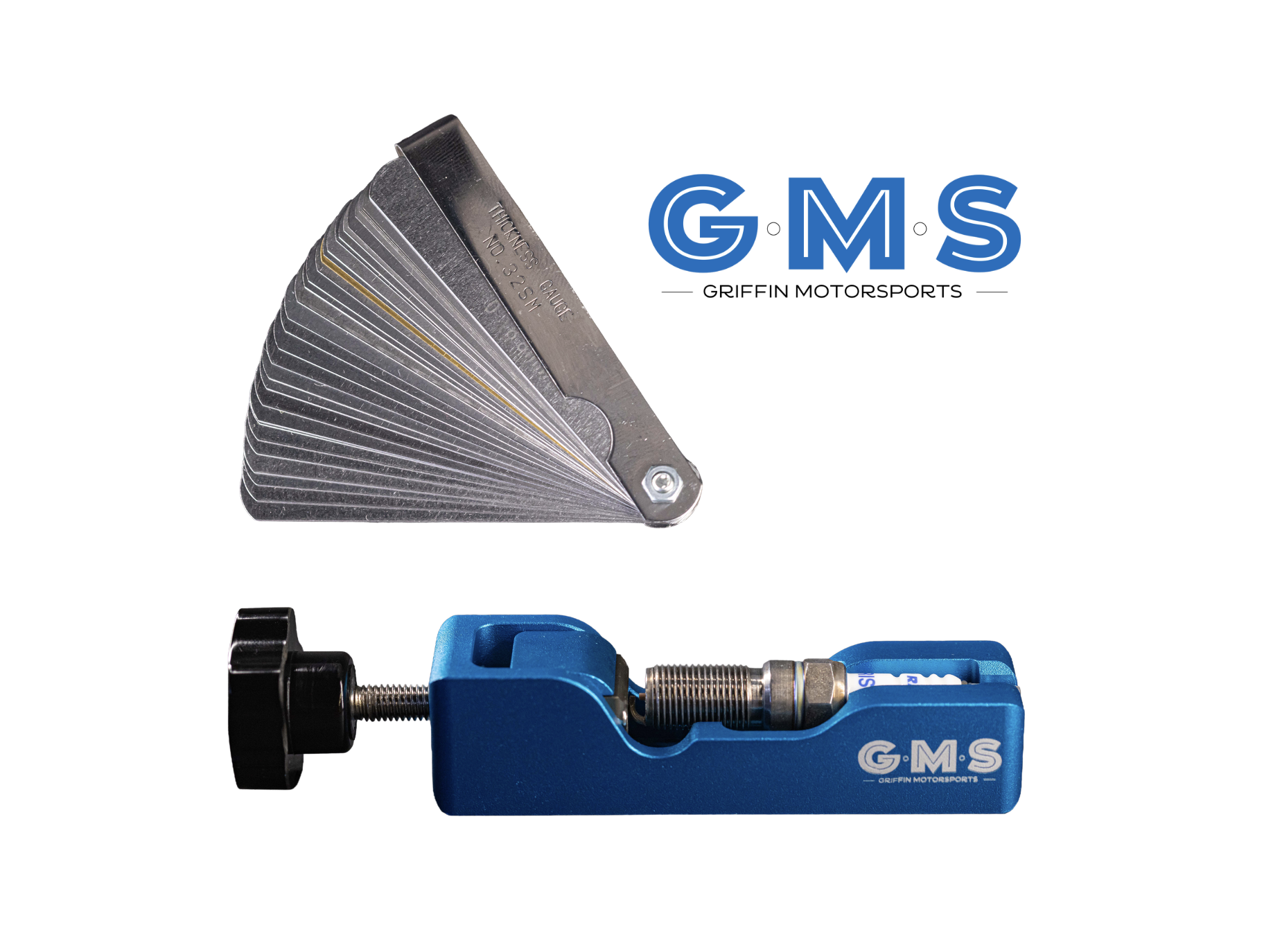
GMS Precision Spark Plug Gap Tool Kit
Because it’s never too late to step up your GAP GAME.
When you’re building and maintaining a high horsepower / boosted motor, spark plug gap matters more than most people realize.
Too wide, and you risk spark blowout under boost. Too tight, and you can sacrifice combustion efficiency, drivability, idle quality, and throttle response.
The problem?
Many enthusiasts still gap plugs using cheap coin-style tools, or by tapping the electrode against a bench. That approach works… until it doesn’t.
The GMS Precision Spark Plug Gap Tool Kit was designed to give Camaro, Corvette, CTS-V, and high-performance GM owners a cleaner, safer, and more repeatable way to gap spark plugs correctly.
Built for modern iridium and silver racing plugs, this tool allows for controlled, precise adjustments without abusing the fragile center electrode or distorting the ground strap.
Whether you’re installing fresh plugs in a stock LT1 or dialing in a 1,000+ horsepower boosted LT4, proper spark plug gap is one of the simplest ways to improve ignition consistency and reduce misfires under load.
Why Spark Plug Gap Matters
Modern direct injected engines operate under significantly higher cylinder pressure than older platforms.
Add: Supercharger / Turbo boost, E85, Aggressive timing, Higher compression, Increased RPM …and ignition demand rises dramatically.
As cylinder pressure increases, the spark becomes harder to maintain. If the spark plug gap is too large, the spark can literally be “blown out” under load, causing:
High RPM breakup
Misfires under boost
Power loss
Knock retard
Inconsistent dyno performance
Poor drivability
Increased stress on ignition components
Properly setting spark plug gap helps maintain a stable spark kernel under high cylinder pressure conditions.
Why Cheap Gap Tools (or no tools) Cause Problems
Most inexpensive spark plug gap tools bend the ground strap unevenly or apply force in the wrong location.
That can: Distort the electrode, Damage fine-wire iridium tips, Crack porcelain, create inconsistent gap measurements, Alter spark exposure to the combustion chamber.
The GMS Precision Gap Tool was selected specifically because it allows for controlled, repeatable adjustment using a threaded compression-style design.
Key Features:
Compact & Portable
Protects Fragile Electrodes.
Precision Aluminum Construction.
Includes 32-Blade Feeler Gauge tool.
Controlled Adjustment Mechanism allows for Repeatable Results.
Lightweight, durable, and designed for repeated shop or track use.
More accurate and consistent than pry-style or coin-style gap tools.
Allows precise gap measurement across a wide range of applications.
Allows smooth, even movement of the ground strap for safer and more accurate gap changes.
Compatible with most standard style spark plugs including:
Brisk
NGK
Denso
AC Delco
Many aftermarket racing plugs
What’s in the box?
GMS Precision Spark Plug Gap Tool
32-Blade Feeler Gauge Set
QR code for a “how to video”
Final Thoughts
A spark plug may cost only a few dollars… but when ignition problems start showing up at 15+ psi of boost and 800+ wheel horsepower, plug gap suddenly becomes very important.
The GMS Precision Spark Plug Gap Tool Kit gives you a cleaner, safer, and more professional way to set plug gap accurately for your specific combination.
Because consistency matters.
GMS Spark Plug Gap Tool
The GMS Precision Spark Plug Gap Tool Kit was designed to give Camaro, Corvette, CTS-V, and high-performance GM owners a cleaner, safer, and more repeatable way to gap spark plugs correctly.
Built for modern iridium and silver racing plugs, this tool allows for controlled, precise adjustments without abusing the fragile center electrode or distorting the ground strap.
Whether you’re installing fresh plugs in a stock LT1 or dialing in a 1,000+ horsepower boosted LT4, proper spark plug gap is one of the simplest ways to improve ignition consistency and reduce misfires under load.
$25.00 Original Price:$35.00
The Ultimate Spark Plug Gap Guide for High-Performance & Boosted Engines
The Smallest Measurement in Your Engine Can Have One of the Biggest Impacts on Performance
You can spend $20,000 building an engine, install premium cylinder heads, upgrade the supercharger, invest in a high-end ignition system, and still lose horsepower—or worse, chase frustrating misfires—because your spark plug gap is off by just a few thousandths of an inch.
It's one of the smallest measurements on your entire engine, yet it's responsible for one of the most critical events occurring thousands of times every minute: igniting the air-fuel mixture inside each cylinder.
Unfortunately, spark plug gap is often treated as an afterthought.
Many enthusiasts assume new spark plugs arrive perfectly gapped from the manufacturer. Others rely on inexpensive coin-style gap tools or never verify the gap after shipping. On a mild street car, those shortcuts may never cause a noticeable problem.
On a boosted or high-performance engine, however, they're mistakes that can quickly reveal themselves under load.
At Griffin Motorsports, we've found that ignition issues are frequently blamed on coils, injectors, fuel quality, or tuning when the real culprit is something much simpler: improperly gapped spark plugs.
The good news?
It's also one of the easiest problems to prevent.
Whether you're installing fresh plugs in a daily-driven Camaro SS, dialing in a supercharged LT4, or preparing a four-digit horsepower drag build, understanding spark plug gap—and using the right tools to set it accurately—can make the difference between consistent power delivery and frustrating troubleshooting sessions.
In this guide, we'll explain how spark plug gap affects combustion, why boosted engines demand greater precision, what causes spark blowout, how different spark plug materials influence ignition performance, and why a quality gap tool is one of the smartest investments you can make when working on any high-performance engine.
Why Spark Plug Gap Matters
Every combustion event begins with a spark.
When the ignition coil releases stored electrical energy, that voltage must jump the tiny gap between the spark plug's center electrode and ground strap. That electrical arc ignites the compressed air-fuel mixture, creating the flame front that ultimately produces power.
While the gap itself measures only a few thousandths of an inch, changing that distance directly affects the voltage required to fire the plug.
A wider gap generally exposes more of the air-fuel mixture to the spark, promoting efficient combustion under the right conditions. However, it also requires the ignition system to generate a higher voltage to bridge that distance.
As cylinder pressure increases—whether from boost, higher compression, aggressive ignition timing, or heavy engine load—the ignition system must work even harder to fire the plug consistently.
That relationship is why spark plug gap becomes increasingly important as horsepower climbs.
A naturally aspirated street engine may tolerate a relatively wide gap without issue, while a supercharged LT4 running 18–25 psi of boost can experience ignition breakdown if the gap is too large.
Finding the correct balance is critical. Too much gap increases the voltage demand beyond what the ignition system can reliably provide under high cylinder pressure. Too little gap can reduce the spark kernel, affecting flame propagation and combustion efficiency.
The goal isn't simply to run the smallest possible gap—it's to run the correct gap for your specific combination.
Griffin Motorsports Insight
One of the biggest misconceptions we see is that installing premium spark plugs automatically improves ignition performance.
The reality is that the best spark plug in the world can't perform at its full potential if it's improperly gapped.
Before replacing ignition coils, changing tunes, or chasing fuel system problems, always verify that every plug is the correct heat range, properly torqued, and accurately gapped. Those simple checks can eliminate many of the ignition issues enthusiasts encounter on boosted applications.
Why Boost Changes Everything
One of the biggest reasons naturally aspirated engines can often get away with a wider spark plug gap is because they're operating under significantly lower cylinder pressure than forced induction engines.
As boost increases, so does the density of the air-fuel mixture inside the combustion chamber.
That denser mixture is excellent for making horsepower—but it also creates a much more difficult environment for the ignition system.
Every time the ignition coil fires, it must generate enough voltage for electricity to jump the gap between the spark plug's center electrode and ground strap. Under normal driving conditions, that's a relatively easy task.
Under 20 pounds of boost? Not so much.
The compressed air-fuel mixture becomes increasingly resistant to electrical flow, meaning the ignition system must work substantially harder to initiate combustion.
Think of it like trying to jump across a creek. A three-foot jump is easy. A six-foot jump requires considerably more effort. The spark plug gap hasn't changed—but the amount of energy required to bridge it has.
That's exactly what happens inside a boosted engine. As cylinder pressure rises, the voltage required to fire the spark plug increases dramatically.
If the ignition system cannot generate sufficient voltage before the piston reaches the ideal ignition point, combustion becomes inconsistent—or may not occur at all.
This is why ignition systems that work perfectly on naturally aspirated engines can suddenly begin experiencing problems once boost levels increase.
Griffin Motorsports Insight
Many enthusiasts assume that installing a stronger ignition coil allows them to run any spark plug gap they want.
While upgraded ignition components certainly provide additional performance margin, they don't eliminate the relationship between cylinder pressure and ignition demand.
The correct spark plug gap should always be determined by the entire engine combination—not simply by installing a more powerful ignition system.
What Is Spark Blowout?
One of the most common ignition problems in high-performance forced induction engines is something known as spark blowout. Despite the name, nothing is actually "blowing out."
Instead, the ignition system simply reaches a point where it can no longer consistently generate enough voltage to force the spark across the plug gap while cylinder pressure is at its highest. When that happens, the spark either becomes weak, inconsistent, or fails to occur altogether. From the driver's seat, it often feels like the engine suddenly hits a wall.
The car may pull cleanly through the lower RPM range, only to stumble or hesitate once boost reaches its peak. Many enthusiasts immediately assume they have:
A bad fuel pump
Injector problems
A tuning issue
A failing ignition coil
Poor fuel quality
In reality, the spark plug gap may simply be too wide for the amount of cylinder pressure the engine is producing. Reducing the gap slightly decreases the voltage required for the spark to occur, allowing the ignition system to fire more consistently under heavy load.
That's why experienced tuners often tighten spark plug gap as boost pressure increases. The objective isn't to make the spark stronger. It's to ensure the spark happens every single time, even under the most demanding operating conditions.
Why Spark Blowout Usually Appears at High RPM
One of the reasons spark blowout can be so frustrating to diagnose is that the engine often runs perfectly under normal driving.
Idle quality may be excellent. Cruising feels completely normal. Light throttle acceleration is smooth. Then, during a full-throttle pull, the engine suddenly begins breaking up near the top of the RPM range.
This isn't a coincidence. At higher engine speeds, several demanding conditions occur simultaneously:
Cylinder pressure is significantly higher.
Boost pressure is often at its peak.
The ignition coils have less time to recharge between firing events.
The engine requires reliable combustion every few milliseconds.
These factors combine to place maximum stress on the ignition system. If the spark plug gap is too large—or the ignition system is already operating near its limit—the problem often reveals itself only during these extreme conditions.
Common Symptoms of Incorrect Spark Plug Gap
Improper spark plug gap doesn't always produce obvious warning signs. In many cases, the symptoms mimic entirely different problems, leading enthusiasts to replace perfectly good parts while the real issue remains unchanged.
Some of the most common symptoms include: Misfires Under Boost. Perhaps the most recognizable symptom of excessive spark plug gap is an engine that pulls cleanly until boost builds, then begins misfiring or stumbling during wide-open throttle acceleration.
High-RPM Breakup
The engine may feel as though it suddenly stops accelerating, almost as if it's encountering a soft rev limiter before reaching the actual RPM limit.
Inconsistent Power Delivery
Instead of smooth acceleration, power may fluctuate as combustion becomes inconsistent from one firing event to the next.
Difficult Cold Starts
Although less common on performance applications, improper gap can occasionally contribute to harder starting conditions—particularly when combined with rich fueling or colder spark plug heat ranges.
Rough Idle
While many boosted engines idle aggressively because of camshaft selection, incorrect spark plug gap can also contribute to inconsistent combustion at idle speeds.
Increased Knock Retard
Incomplete combustion caused by ignition problems can sometimes produce data that resembles knock activity, leading tuners to chase fueling or timing adjustments before discovering the true cause.
Griffin Motorsports Insight
One of the most expensive mistakes enthusiasts make is replacing parts before verifying the basics. We've seen customers replace ignition coils, injectors, sensors, and even schedule dyno retunes, all because of a spark plug gap that could have been corrected in less than an hour.
Whenever ignition issues appear after installing new spark plugs, checking the gap should be one of the very first diagnostic steps.
Diagnosing the Problem Before Replacing Parts
Because ignition issues often resemble fueling or tuning problems, it's important to approach diagnosis methodically. Before replacing expensive components, consider the following questions:
Did the problem begin immediately after installing new spark plugs?
Were the plugs individually checked before installation?
Has boost pressure recently been increased?
Was a smaller supercharger pulley installed?
Has ignition timing been made more aggressive?
Are you running a different fuel than before?
Has the engine combination changed in a way that increases cylinder pressure?
Answering these questions often narrows the problem considerably before unnecessary parts are purchased.
Remember, premium ignition components can't compensate for a spark plug that's improperly prepared.
Spark Plug Material Matters, But Probably Not for the Reason You Think
One of the most common misconceptions in the performance world is that all premium spark plugs are essentially the same. They're not.
Different electrode materials have different electrical conductivity, thermal conductivity, durability, and wear characteristics. Those properties directly influence how a spark plug performs under different operating conditions.
However, it's important to understand one critical point, Spark plug material does NOT determine heat range. That's a completely separate design characteristic.
You can purchase iridium plugs in multiple heat ranges. Silver plugs in multiple heat ranges. Nickel plugs in multiple heat ranges. Choosing the correct heat range is based on your engine combination, while choosing the electrode material is based on balancing performance, longevity, and intended use.
Understanding the difference helps eliminate a tremendous amount of confusion.
The Four Most Common Spark Plug Electrode Materials
Today's performance market is dominated by four primary electrode materials:
Nickel Alloy
Platinum
Iridium
Silver
Each has advantages.
Each has disadvantages.
The best choice depends entirely on how your engine is used.
Nickel Alloy Spark Plugs
Nickel alloy has been the standard spark plug material for decades.
It's inexpensive, durable enough for factory applications, and performs well in naturally aspirated street engines.
For stock daily drivers, nickel plugs often provide excellent reliability. However, they aren't typically the first choice for high-performance boosted combinations.
Because nickel isn't as electrically conductive as silver and doesn't allow extremely fine-wire electrode designs like iridium, it generally requires more ignition energy and experiences faster electrode wear under demanding conditions.
Best For
Stock engines
Naturally aspirated street cars
Budget maintenance
Advantages
Affordable
Readily available
Reliable for OEM applications
Tradeoffs
Shorter service life
Larger electrode design
Less efficient conductivity than premium materials
Platinum Spark Plugs
Platinum became popular because of its exceptional durability.
The material resists erosion extremely well, allowing manufacturers to extend maintenance intervals considerably compared to traditional nickel plugs.
That's one reason many factory vehicles now leave the assembly line equipped with platinum or iridium plugs. For typical commuter vehicles, platinum performs exceptionally well. For serious performance applications, however, longevity often becomes less important than ignition performance.
Most enthusiasts pushing substantial horsepower eventually move toward iridium or silver depending on their priorities.
Best For
Daily drivers
Long maintenance intervals
Factory replacement
Advantages
Excellent durability
Long service life
Tradeoffs
Lower electrical conductivity than silver
Less common in dedicated racing applications
Iridium Spark Plugs
Iridium has become the benchmark for modern high-performance street engines.
Its exceptional hardness allows manufacturers to produce an extremely fine center electrode without sacrificing durability. That fine-wire design requires less voltage to initiate a spark while maintaining excellent resistance to wear over tens of thousands of miles.
For enthusiasts who want premium ignition performance combined with long service life, iridium is often an outstanding choice. This is one reason iridium plugs are so popular in modern Camaros, Corvettes, and other late-model performance vehicles.
Best For
Daily driven performance cars
Weekend street cars
Mild to moderately boosted applications
Enthusiasts seeking long service life
Advantages
Extremely long lifespan
Fine-wire center electrode
Excellent ignition consistency
Minimal maintenance
Tradeoffs
More expensive than nickel
Electrical conductivity is still lower than silver
Griffin Motorsports Insight
Many enthusiasts assume that because iridium plugs cost more than traditional plugs, they must also produce more horsepower.
In reality, iridium's greatest strength isn't additional power, it's maintaining consistent ignition performance over an exceptionally long service life.
For many street-driven Camaros, that's exactly what makes them an excellent choice.
Silver Spark Plugs
If maximum ignition performance is the goal, silver occupies a unique position. Silver is the most electrically conductive metal of any element on the periodic table.
That exceptional conductivity allows electrical energy to transfer through the electrode with remarkable efficiency, making silver plugs especially attractive in applications where cylinder pressure places tremendous demands on the ignition system.
High-boost supercharged engines, turbocharged combinations, and dedicated race cars often benefit from silver's outstanding conductivity because reliable spark initiation becomes increasingly critical as horsepower climbs.
The tradeoff? Silver is considerably softer than iridium.
While it offers outstanding ignition performance, it typically doesn't provide the same service life as an iridium plug in everyday street use. For many enthusiasts, that's an easy compromise.
Replacing spark plugs periodically is inexpensive compared to chasing ignition problems on a high-horsepower engine.
Best For
High-boost supercharged engines
Turbocharged applications
E85 combinations
Competition vehicles
High-horsepower street builds
Advantages
Highest electrical conductivity available
Excellent ignition efficiency
Outstanding performance under high cylinder pressure
Preferred by many experienced tuners
Tradeoffs
Shorter service life than iridium
More frequent replacement intervals
Why Griffin Motorsports Recommends Brisk Racing Spark Plugs
At Griffin Motorsports, we work with everything from lightly modified street cars to four-digit horsepower LT platforms.
Because of that, we've had the opportunity to evaluate numerous spark plug options across a wide variety of combinations. For many boosted LT applications, we've consistently had excellent success with Brisk Racing Silver Spark Plugs.
Their combination of high electrical conductivity, consistent manufacturing quality, and excellent performance under elevated cylinder pressure makes them one of our preferred choices for aggressive street cars, drag cars, and road course builds.
That doesn't mean silver is automatically the correct answer for every customer. Many daily driven Camaros are better served by Brisk Racing Iridium Spark Plugs, particularly when long maintenance intervals are a priority.
Rather than recommending one spark plug for every application, we prefer matching the spark plug to the customer's actual goals.
Griffin Motorsports Insight
One of the biggest mistakes we see isn't choosing the "wrong" spark plug.
It's expecting one spark plug to be perfect for every combination. A 600 RWHP daily driver and a 1,200 RWHP drag car simply have different ignition requirements.
Choosing the right plug means understanding how the vehicle is driven—not just how much horsepower it makes.
Quick Comparison
|
Feature |
Nickel |
Platinum |
Iridium |
Silver |
|---|---|---|---|---|
|
Street Use |
★★★★★ |
★★★★★ |
★★★★★ |
★★★★☆ |
|
High Boost |
★★☆☆☆ |
★★★☆☆ |
★★★★☆ |
★★★★★ |
|
Electrical Conductivity |
★★☆☆☆ |
★★★☆☆ |
★★★★☆ |
★★★★★ |
|
Service Life |
★★☆☆☆ |
★★★★★ |
★★★★★ |
★★★☆☆ |
|
Feature |
Nickel |
Platinum |
Iridium |
Silver |
|---|---|---|---|---|
|
Racing Applications |
★★☆☆☆ |
★★☆☆☆ |
★★★★☆ |
★★★★★ |
|
Daily Driver |
★★★★★ |
★★★★★ |
★★★★★ |
★★★★☆ |
Recommended Starting Spark Plug Gaps
One of the most common questions we receive is:
"What spark plug gap should I run?"
While there is no universal answer, the combinations below represent common starting points based on our experience with Gen V LT engines. These values are intended as general guidelines only. Every engine combination is different, and your engine builder or tuner should always have the final recommendation.
Stock LT1 (Naturally Aspirated)
Typical Starting Gap .040–.045"
Factory naturally aspirated combinations generally tolerate wider spark plug gaps because cylinder pressures remain relatively low compared to forced induction applications.
If your ignition system is healthy and the engine remains close to stock, the factory-recommended specification is usually appropriate.
Bolt-On LT1
Typical Starting Gap .028–.032"
Cold air intake, headers, E85 tuning, camshaft upgrades, and increased cylinder pressure often benefit from slightly tighter spark plug gaps.
This provides additional ignition reliability without unnecessarily reducing spark kernel size.
Mild Supercharged LT4 (14-18PSI)
(Factory blower with pulley upgrades or mild aftermarket blower)
Typical Starting Gap .022–.026"
As boost pressure increases into the mid-to-high teens, ignition demand rises significantly. Many tuners begin tightening spark plug gap within this range to reduce the likelihood of spark blowout during full-throttle acceleration.
High-Boost LT4 (20+ PSI)
Typical Starting Gap .020–.022"
High cylinder pressure dramatically increases the voltage required to fire the spark plug. A tighter gap often improves ignition consistency while maintaining reliable combustion under heavy load.
Griffin Motorsports Insight
We don't recommend chasing someone else's spark plug gap.
Every time someone posts,
"I'm running .018."
or
"Mine are gapped at .030."
there are dozens of variables they haven't mentioned:
Boost level
Fuel type
Compression ratio
Camshaft
Ignition coils
Altitude
Tune
Air inlet temperatures
Intended RPM
The correct gap is the one that provides consistent combustion in YOUR engine, not someone else's.
A Quick Note About Fine-Tuning
Spark plug gap isn't a one-time decision.
As your combination changes, your ignition requirements often change as well.
Examples include:
Installing a smaller supercharger pulley
Switching from pump gas to E85
Increasing ignition timing
Upgrading cylinder heads
Adding nitrous
Changing compression ratio
Installing a larger supercharger
Moving to a turbocharger
Increasing boost pressure
Whenever cylinder pressure changes significantly, spark plug gap should be re-evaluated.
Sources & References
The recommendations and technical information presented throughout this guide are based on a combination of engineering principles, manufacturer documentation, and real-world experience preparing and supporting high-performance Gen V LT engine combinations.
Additional resources include:
Brisk USA Technical Information
GM Service Information
ACDelco Spark Plug Specifications
NGK Technical Resources
Denso Technical Publications
Griffin Motorsports product testing and customer support experience
About Griffin Motorsports
At Griffin Motorsports, our goal isn't simply to sell performance parts.
Our mission is to help enthusiasts understand why those parts matter.
Every product we offer is selected because we believe it delivers measurable value, whether you're building a comfortable weekend cruiser, a dedicated road course car, or a four-digit horsepower drag build.
Our Technical Library is designed to share the same information we discuss with customers every day—real-world guidance backed by experience, not marketing hype.
If you ever have questions about your combination, we're always happy to help.
Because better information builds better cars.